
Check out This Date in History for Dec. 24, in MainStream’s daily look at significant progressive, intersectional historical events.
1818: Christmas carol “Silent Night” is composed within minutes by Franz Xaver Gruber. It’s performed for the first time ever at St Nicholas Parish Church in Oberndorf, Austria.
1826: The Eggnog Riot at West Point Academy triggers broken windows, assaults on officers, the arrests of 70 cadets, and the court-martialing or expulsion of 20. Defying their new leaders’ ban on alcohol on campus, the cadets smuggled whiskey on-site the day before Christmas.
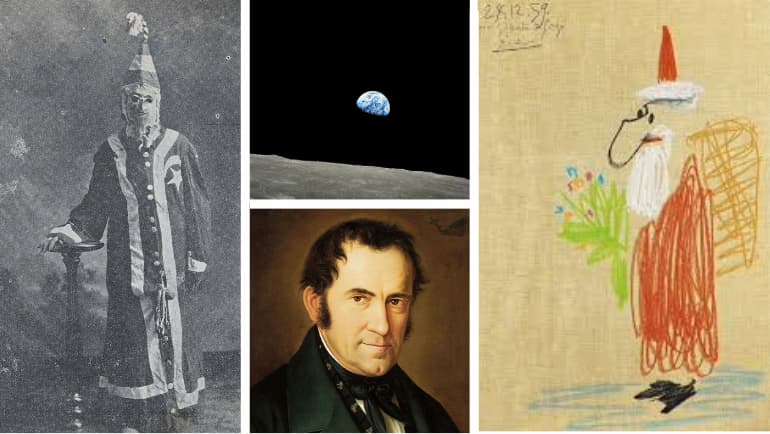
Clockwise from top left: an early Ku Klux Klan uniform, the famous Earthrise photo, Picasso’s crayon Santa Claus sketch, and Franz Xaver Gruber, author of “Silent Night.”
1832: The first medical institution for Black Americans, the Georgia Infirmary, opens its doors to aid “aging and afflicted” African-Americans. The hospital served mostly slaves, many of whom did not receive health care for much of their lives or were abandoned by their former owners when they aged or became ill. Closed and destroyed during the Civl War and then rebuilt, the infirmary still operates today as the fully-desegregated Adult Day Center-Georgia Infirmary.
1865: The Ku Klux Klan, eventually described by scholar W.E.B. DuBois as “armed guerilla warfare” forms in Pulaski, Tenn., led by several former Confederate soldiers. The Klan acted secretly with the support of many Southern White people, terrorizing and murdering mostly Black Americans, but also Jews, Catholics, immigrants and Northern sympathizers. Tts version of the Klan would be disbandeded by an act of Congress a few years later; the Klan would re-emerge in the early 1920s and 1930s..
1914: The famed World War I Christmas Truce happens throughout Europe when opposing soldiers sing “Stille Nacht,” shake hands, trade cigarettes, sing carols, and more. “The war, for that moment, came to a standstill,” remembered one soldier.
1923: The first outdoor National Christmas Tree is lit by President Calvin Coolidge, before a crowd of over 5,000. The lighting of the large balsam fir on the White House lawn starta a new seasonal presidential tradition.
1924: The oldest documented LGBTQ+ organization forms, when the Society for Human Rights receives a charter in Illinois. The Society also created Friendship and Freedom, America’s first publication for homosexuals. It disbanded in less than a year after a member’s wife reported the group to the police, resulting in several arrests and expensive court costs.
1948: The first-ever fully solar-powered house welcomes its first residents, the Nemethys from Hungary. The so-called Dover Sun House in Massachusetts functioned unrelaibly for three years, using a system that absorbed energy from the sun and stored it in salt.
Also in 1948, the Air Force announced it was tracking Santa’s path. “One unidentified sleigh, powered by eight reindeer, at 14,000 feet, heading 180 degrees,” the force’s message says. In 1955, the North American Aerospace Defense Command (NORAD) picked up the practice and portrays Santa’s path on its website even today.
1959: Pablo Picasso uses wax crayons to create an impromptu sketch of “Santa Claus“ for his friends that eventually sold for $137,500.
1952: The foundations of modern-day immigration policy are laid when the McCarran-Walter Act takes effect, prioritizing immigration by skilled workers and then family reunification. The law also required almost 95% of immigrants to be from Europe and remains in place until 1965.
1968: The first color photograph of Earth taken from space circulates the globe, taken by Astronaut William Anders from the Moon during the Apollo 8 mission. Called Earthrise, the photo is featured on posters for the first-ever Earth Day two years later and is credited with propelling environmental awareness.
2009: The U.S. Senate passes its version of what will become known as ObamaCare, the Affordable Care Act. The move sets up the ACA to hecome law in 2010, transforming the health insurance market to require coverage of those with pre-existing conditions, and also providing new options to the self-employed and small business owners.
2014: A lifetime ban on gay men donating blood is lifted by the Food and Drug Administration (FDA), but men who have had sex with men within the last year are still prohibited until 2020, when that period is shortened to three months. In 2023, the prohibition will be lifted altogether. The bans had been in place as a safeguard against the transmission of HIV through blood donation.
Photos courtesy Wikimedia Commons.