
Check out This Date in History for Dec. 28, in MainStream’s daily look at significant progressive, intersectional historical events.
1793: Author Thomas Paine is imprisoned in France after being convicted of treason for publishing Rights of Man, which supported voting rights for all and ending the French monarchy, among other things. Paine’s 11 months in prison included a multi-room cell with windows, catered meals and an affair. He had also been charged with treason a decade earlier in England.
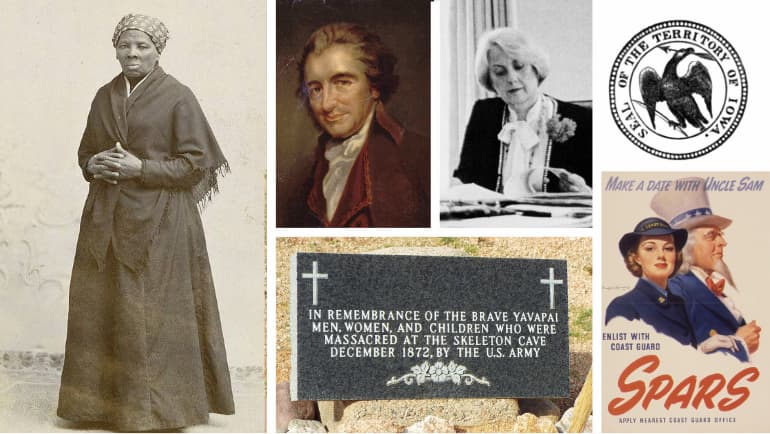
Clockwise from left: Harriet Tubman, Thomas Paine, Muriel Siebert, the Iowa Territorial Seal before it became a state; the SPARS unit of female Coast Guard cadets; and a plaque honoring those killed in the Skeleton Cave Massacre.
1816: The American Colonization Society forms, promoting the recruitment of African-Americans to leave America for African countries. Some labeled the movement covert racism; others saw it as an opportunity. Despite having support of the government for decades, the movement led to only 10,000 people relocating to the new colony of Liberia. President Abraham Lincoln was a member of the group before and during his presidency.
1846: Iowa is declared the 29th state of the United States of America, 13 years after it was first declared a territory. Iowa City in eastern Iowa would serve as the state capital until 1857, when ongoing calls for a more central capital would lead to state offices relocating to Des Moines.
1860: Harriet Tubman completes her last mission to free slaves and settles briefly into her home in Auburn, N.Y., after 10 years of helping other former slaves through the Underground Railroad. Sadly, her last mission forced her to leave behind her niece and nephew while she successfully escorted dozens of others to safety.
1872: More than 100 Apache men, women and children seeking refuge are killed by the U.S. Army in the Skeleton Cave Massacre in Arizona.The Apache were seeking refuge after decades of “encroachment on their lands, broken treaties, and forced relocations.”
1895: Two French brothers show a film of kids playing in the ocean, when the world’s first commercial movie screening happens in Paris. See it below.
1942: The first-ever female members of the U.S. Coast Guard begin training at the Naval Academy. The unit featured just 13 women, known as SPARs (Semper Paradus Always Ready), and triggered a four-year recruitment of 10,000 females.
1956: Rosa Jordan, 22, a Black pregnant woman from Montgomery, Ala., is shot in the legs by white snipers a week after the U.S. Supreme Court ordered an end to segregated busing there. Her shooting caused the city to shut down busing after 5 p.m. for the next month.
1967: Muriel Siebert becomes the first female member of the New York Stock Exchange when she finds a sponsor and raises the $450,000 needed to buy a seat. Siebert would go on to be appointed New York’s first female superintendent of banking and would be inducted into the National Women’s Hall of Fame.
1973: Credited with saving 90 percent of endangered species and now covering 2,000 plants and animals, the Endangered Species Act is signed into law by U.S. President Richard Nixon.
1974: Aleksandr Solzhenitsyn releases “Gulag Archipelago,” an account of the imprisonment and torture of millions of Soviet citizens from 1918 to 1956 under Stalin and other totalitarian leaders. The book caused Solzhenitsyn’s expulsion from the Soviet Union and “inspired human rights activism, encouraging a focus on individual cases of injustice rather than on broad political critiques,” writes EBSCO.
1976: Karen Farmer becomes the first African American member of the Daughters of the American Revolution after her genealogy search reveals she is a descendant of a Revolutionary War soldier. The DAR had previously been known for racism after refusing singer Marion Anderson’s membership in the early 20th century.
Also in 1976, America welcomes the first-ever baby conceived through in vitro fertilization (IVF), Elizabeth Jordan Carr. Today, 500,00 babies annually are born through IVF.
1990: Fans of The Grateful Dead circulate a flier encouraging a nationwide post-smoking paprty in four months, in what is largely considered to be the founding of the phrase and tradition of 420.
2012: Americans can no longer adopt Russian children, under an order from Vladimir Putin. Russian officials said the ban was triggered by excessive deaths of Russian children adopted by Americans, while American officials contend the ban was a retaliatory move after the U.S. took actions against some Russian businesspeople.
2017: Five years before anti-hijab protests rippled across Iran when a 22-year-old woman arrested for removing her hijab dies in police custody, Vida Mohaved is arrested for removing her hijab and inspires protests across the country. She’d spend a year in jail and is celebrated annually, though never seen in public.
2023: L’Oréal heiress and businesswoman Françoise Bettencourt Meyers is the first woman to be worth $100 billion. Though she is now the second-most wealthy woman in the world, Meyers is still valued at $82 billion.
Photos courtesy Wikimedia Commons.