
Check out This Date in History for Jan. 1, in MainStream’s daily look at significant progressive, intersectional historical events.
404: After six centuries, gladiator competitions in Rome end. The bloody form of entertainment mostly involved slaves, criminals or prisoners of war, but by this time, about half of gladiators were volunteers who agreed to risk their lives voluntarily.
1804: Haiti becomes independent from France after 13 years of revolution and conflict and also becomes the first country founded by a slave rebellion. Seven years later, slavery is reimposed by Napoleon.
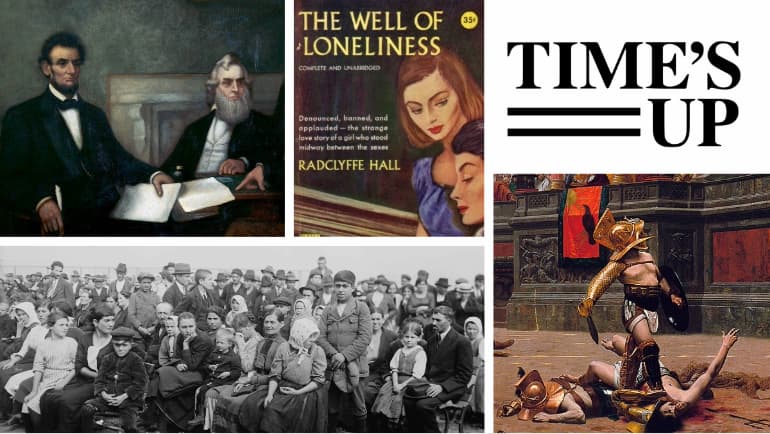
From top left: President Abraham Lincoln and Secretary of the Navy Gideon Welles at the signing the Emancipation Proclamation; “The Well of Loneliness” banned lesbian novel; Time’s Up logo; painting of a gladiator; and immigrants at Ellis Island.
1808: The transatlantic slave trade was supposed to end when new slave import is abolished. The Act to Prohibit the Importation of Slaves doesn’t actually stop the import of thousands of slaves a year from other countries, but it slows the practice. Domestic slavery continues until 1865.
1852: The first public bath in the United States opens in New York City, considered a key step forward in public health for the low-income, who didn’t have access to running water. The People’s Bath and Washing Establishment functioned until 1861 with separate communal baths for men and women, but was too expensive for most low-income families. After years of debate, public bath houses would return to New York City in the early 1900s, but the wider availability of running water eventually rendered public bathhouses obsolete.
1863: Abraham Lincoln issues the final Emancipation Proclamation, after issuing an initial version Sept. 22. The move triggers the Civil War and also, doesn’t end slavery in Texas. That will happen two years later when Juneteenth is born.
1892: Ellis Island opens as an immigration station when Annie Moore, 17, emigrates from Ireland. Over the next 62 years, 12 million Americans will pass through Ellis Island, representing the ancestors of up to 40% of Americans.
1916: The first blood transfusion using chilled and stored blood is performed by Oswald Hope Robertson to help World War I soldiers on the battlefield. Robertson would eventually found the first blood bank.
1928: The Well of Loneliness, is published and immediately banned in England, though allowed to publisih in the United State, after being labelled “obscene libel” for its depiction of a lesbian (or possibly, a lesbian/trans’ man) relationship. The novel by Radclyffe Hall is about a socialite who dresses in masculine clothes and is attracted to women. It becomes an international bestseller and is the first-ever lesbian novel to be banned.
1957: The Sexual Offence Act becomes law in the United Kingdom, criminalizing some acts between two men, but not two women. “The introduction of the term ‘sexual offences’ marked a shift in the legal landscape, reframing offenses as violations against societal moral standards rather than simply personal harm.”
Listen to Paul Volberding, co-founder of the world’s first-ever AIDS clinic in 1987, talk about how HIV/AIDS treatment and prevention have evolved over the years.
1962: Illinois becomes the first state to abolish anti-sodomy laws. Paul Goldman, a straight Chicago lawyer, led the fight for change, inspired by the suicide of a gay college roommate. The code change still banned “lewd fondling” with the same sex, which was soon changed to all sexes before being removed altogether in 1984.
1967: Two years before Stonewall, which many credit with starting the gay rights movement, a police raid on Los Angeles’ Black Cat Tavern leads to the first precedent for “asserting in court that gays deserve equal protection under the law.” More than 200 people turned out the following month for a peaceful demonstration against police violence outside the popular gay bar.
1983: The world’s first dedicated outpatient AIDS clinic, Ward 86, opens at San Francisco General Hospital. The clinic leads the way in modelling how to treat patients compassionately and sets a worldwide standard for HIV patient care. It continues to operate today.
2000: The Y2K scare, a widespread fear that computer systems would glitch worldwide over the new millennium’s digits, comes and goes with hardly a blip.
2011: Oprah Winfrey starts her own cable television network, the Oprah Winfrey Network (OWN) after running her daily talk show for 25 years. The network is among many projects that have made Winfrey the wealthiest Black woman in the world, with a value of $3.1 billion.
2018: In the wake of the MeToo movement, 300 women in Hollywood start a nonprofit called “Time’s Up” to support sexual assault victims. It woud dissolve five years later, raising more than $24 million. Some of its leaders were eventually revealed to have connections to aformer New York Gov. Andrew Cuomo, accused of sexual assault. The remaining $1.7 million upon the group’s dissolution was donated to a legal fund administered by the National Women’s Law Fund.
Photos courtesy Wikimedia Commons.