Check out This Date in History for Jan. 20, in MainStream’s daily look at significant progressive, intersectional historical events.
1788: The First African Baptist Church, possibly the first Black church in America, is officially recognized while still meeting in a barn in Savannah, Ga. Founded in 1773 by former slave George Leile, the church will grow to over 700 members by 1800 and remains active today.
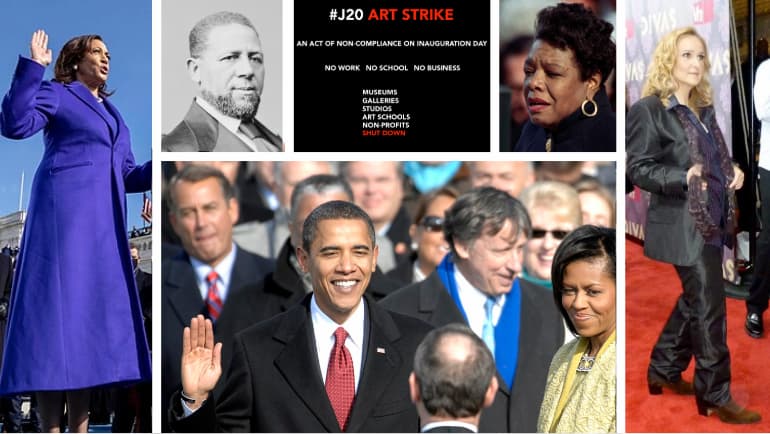
Kamala Harris; Hiram Revels; the J20 Art Strike in 2017; Melissa Etheridge, and former President Barack Obama.
1869: Elizabeth Cady Stanton becomes the first woman to testify before Congress, arguing against the 15th amendment because it granted Black men the right to vote but not Black women. She also said Black people aren’t educated enough to vote, one of several racist remarks she had made that earned her a rebuke by her longtime ally Frederick Douglas.
1870: Rev. Hiram Revels wins an election to become America’s first Black Senator. When inaugurated a month later, he’ll also be the first Black person to serve in Congress. Southern Democrats had tried to disqualify Revels after his election, arguing he didn’t have the required nine years of citizenship to be a Senator.
1900: The first-ever anti-lynching bill is proposed by George Henry White, the only Black person in Congress at the time. The bill dies in committee, White leaves office the following year, and a Black person won’t serve in Congress until 1929.
1942: Adolf Hitler and 14 other high-ranking Nazi officials meet for the “Wannsee Conference,” a gathering at which the Nazi regime decides to amp up its Jewish attacks to all of Europe and “systematically exterminate Europe’s Jewish population on an industrial scale.” Before the end of World War II, the Nazis will murder at least 6 million Jewish people and 6 million others.
1954: The National Negro Network is formed, a nationwide coalition of 40 to 45 Black-owned radio stations. The network closes down a year later when television surges in popularity.
1960: A discharge from the military for homosexuality is overturned for the first time. Fannie Mae Clackum and her partner Grace Garner were demoted and discharged from the Air Force reserves because they were lesbians. A court ruled Clackum had been deprived of due process; she eventually received back pay and a discharge equal to honorable.
1981: The Iran Hostage Crisis ends when 52 Americans held in Tehran for 444 days return home. The Americans were taken hostage when Iranian students stormed the U.S. Embassy to Iran in November 1979. The crisis ended when the country of Algiers intervened and facilitated both countries to make concessions.
1986: The first-ever MLK Day is celebrated, after first being proposed in 1979 to honor Martin Luther King, Jr., the civil rights leader slain in 1968.
Maya Angelou recites her poem “On the Pulse of Morning” at the 1993 inauguration of Bill Clinton.
1993: Maya Angelou is the first woman and Black person to recite a poem at a presidential inauguration, reading her poem “On the Pulse of Morning” at the ceremony installing President Bill Clinton. Her reading earned her a Grammy Award.
Also in 1993, two famous women “come out” as lesbians for the first time, at a time when sexuality was rarely discussed publicly. It happened at Clinton’s Triangle Ball, an LGBQ+ celebration of his inauguration: Melissa Etheridge broke a “don’t ask don’t tell” style policy imposed on her by record company, and Janis Ian announced her sexuality at the encouragement of the Human Rights Campaign. The evening is considered a “turning point” in homosexual openness, and also inspired Ellen DeGeneres’ sitcom “coming out” four years later.
2009: Barack Obama is inaugurated as the first Black president of the United States. Born in Hawaii, Obama worked as a lawyer and teacher at the University of Chicago Law School before entering politics. He served as a senator from Illinois before running for president, and defeated fellow Senators Hillary Clinton in the Democratic primary and John McCain in the general election.
2017: The J20 Art Strike takes place, with hundreds of arts venues agreeing to close on the day of Donald Trump’s first inauguration. The effort was intended to “combat the normalization of Trumpism — a toxic mix of white supremacy, misogyny, xenophobia, militarism, and oligarchic rule,” writes Hyperallergic.
2020: The first COVID-19 case in the United States is confirmed, although the first infections were likely weeks earlier. By Jan. 31, the department of health and human services declares a public health emergency, and the first deaths occur in February. Eventually, 1.2 million Americans will die from the virus, and a total of 100 million will contract it.
2021: Kamala Harris becomes the first woman, first African-American, and first South Asian person to be inaugurated as Vice President of the United States. Born in California to a Jamaican father and Indian mother, Harrisserved as Attorney General and U.S. Senator before becoming vice president.
Photos courtesy Wikimedia Commons. Melissa Etheridge photo courtesy Philip Nelson. Christine Hawes contributed to this report.