Check out This Date in History for January 29, in MainStream’s daily look at significant progressive, intersectional historical events.
1834: Federal forces are used to end a protest for the first time in American history, when President Andrew Jackson sends federal troops to quell a labor protest by Irish immigrants in Maryland. The workers were protesting dangerous and unsanitary factory working conditions.
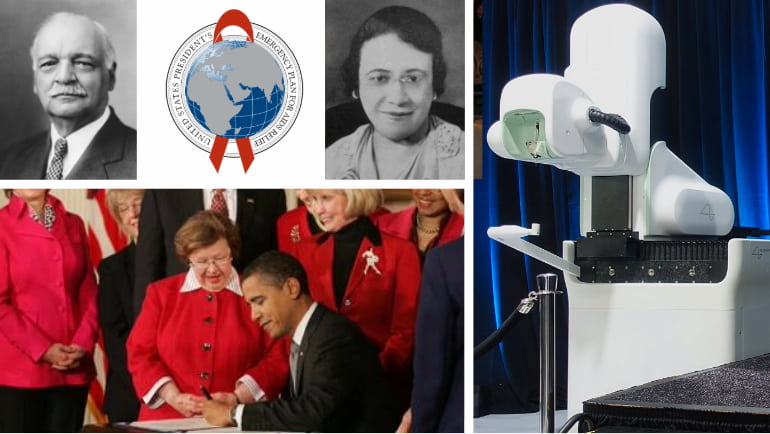
Charles Curtis; the logo for the PEPFAR program; attorney Violette Neatley Anderson; the NeuraLink “brain-reading” device; and President Barack Obama signing the Lily Ledbetter Act while Ledbetter looks on.
1850: A series of bills that will lead to the Fugitive Slave Act are introduced, in the Compromise of 1850. The legislative package, proposed by Henry Clay, aimed to lessen emerging tensions over slavery as America grew, and would include a provision requiring the return of escaped slaves to their “owners.” The bills would be passed eight months later.
1863: U.S. soldiers murder between 250 to 400 Shoshoni children, men and women in the Bear River Massacre, the largest-ever mass murder against Native Americans. The Northern Shoshoni acquired the massacre site in 2019 to protect it as a sacred burial ground and memorial.
1891: The last monarch of Hawaii before it becomes a U.S. territory is crowned. Lili’uokalani will be imprisoned four years later by American settlers. She’d also write “Aloha ʻOe” (“Farewell to Thee”), a popular Hawaiian song, during her imprisonment.
1907: Rep. Charles Curtis of Kansas becomes the first Native American to serve as a U.S. Senator. Among his greatest achievements: introducing the original Equal Rights Amendment in 1921, passed in 1972 yet never adopted. A member of the Kaw Nation, he was already the first native U.S. Representative, and will serve as Vice President under Herbert Hoover. He remains the highest-ranking Native American ever to serve in the federal government.
1926: Violette Neatley Anderson of Chicago becomes the first Black woman to practice law before the U.S. Supreme Court. Anderson was also among the few Black women to attend law school in Illinois, the first woman to operate her own law practice in the state, and a former Vice President of the Illinois Bar.
1929: The first-ever guide dog nonprofit, The Seeing Eye, forms in Nashville, Tenn. The Seeing Eye moves to New Jersey a couple years later, and continues to train dogs for people with disabilities today and has partnered over 18,000 dogs overall with the disabled.
1975: Gay Illini, a student gay rights organization on the University of Illinois’ campus at Champaign-Urbana, is founded as a chapter of the nationwide Gay Liberation Front. The group still exists and hosts panels, movie nights, dances and other events for queer people.
2002: President George W. Bush calls North Korea, Iran and Iraq an “Axis of Evil,” blaming them for terrorism around the world and promising action against their governments. The Bush administration would invade Iraq the following year under the lie that the country’s dictator, Saddam Hussein, secretly had weapons of mass destruction.
2003: The President’s Emergency Plan for AIDS Relief (PEPFAR) kicks off, a five-year, $15 billion plan to reduce HIV/AIDS infections and deaths worldwide. It’s the largest-ever American funding of AIDS prevention, tripling its focus on worldwide HIV/AIDS treatment.
2009: The Lily Ledbetter Act requiring fair pay for women and men is signed by President Barack Obama, the first bill of his presidency. The act is named for Lily Ledbetter, a woman who learned she was being paid less than her male coworkers after 19 years working for Goodyear.
Also in 2009, Illinois’ Gov. Rod Blagojevich is impeached and removed from office by the state Senate after his arrest on charges of corruption. Blagojevich will be convicted in 2011 of trying to sell President Barack Obama’s U.S. Senate seat. He’ll be pardoned by President Donald Trump in 2020.
2014: Archaeologists discover what may be the oldest Roman temple at the modern church of Sant’Omobono. The temple is estimated to be 2,500 years old, dating back to before Rome became a Republic, and showed strong evidence of early engineering prowess by the Romans.
2019: Actor Jussie Smollett tells Chicago police he was attacked by two supporters of Donald Trump, a story revealed within weeks to be false. Two of Smollett’s friends will be arrested for the alleged attack and tell police that Smollett hired them. Smollett is sentenced to 150 days in jail and fined $145,000 in 2022, but his conviction is later reversed by the Illinois Supreme Court due to an earlier plea agreement.
2024: Neuralink’s brain chip, the first “brain-reading” device, is implanted in a human for the first time. Elon Musk, head of the company, predicts the invention will help reinstate movement to people who have lost use of their limbs and lead to other medical innovations. Ethicists express concern about its potential for abuse.
Photos courtesy Wikimedia Commons. Christine Hawes contributed to this report.