
Check out This Date in History for Jan. 22, in MainStream’s daily look at significant progressive, intersectional historical events.
1855: A pivotal step occurs in the colonization of America, when 12 Native American tribes in the Puget Sound area (what is now the state of Washington) cede more than 5 million acres of land to the United States in the Treaty of Point Elliott. In return, the tribes “received” the right to govern themselves and hunt and fish in keeping with their cultural traditions on 22,000 acres of land reserved for them.
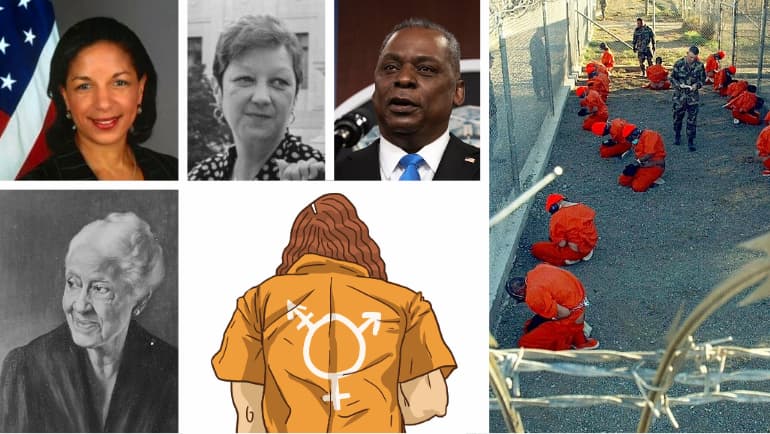
Clockwise from top left: Susan Rice; Norma McCorvey, the plaintiff in Roe V. Wade; Lloyd Austin; Guantanamo Bay inmates; the International Transgender Prisoner Day of Action and Solidarity symbol; and 89-year-old activist Mary Church Terrell.
1908: “No man shall dictate me.” These words were spoken by Katie Mulcahey, as she appeared before a New York City judge defying a new law banning women from smoking in the city’s restaurants. She had spent a night in jail after being arrested for refusing to pay a $5 fine. Mulcahey was released without incident, and the law was repealed less than two weeks later, a key step foward in women’s rights at a time when other sexist policies included most restaurants refusing to even serve women who were not accompanied by a man.
1949: Dr. J. Robert Gladden becomes the first Black person certified as an orthopedic surgeon. He would later become the first non-white person to perform major surgery in Bermuda.
1953: A court rules that Washington, D.C., can ban Blacks from restaurants, in a case that will eventually be overturned by the U.S. Supreme Court. Mary Church Terrell, an 89-year-old civil rights activist, had sued Thompson’s Restaurant three years earlier after she and a group of friends were denied seating. An appeals court ruled the local government did not have the authority to ban segregation and said it was a Congressional responsibility. Terrell appealed the case to the high court later that year and won, but restaurants nationwide would not be desegregated until 10 years later.
1971: For the first time ever, members of Congress boycott a presidential State of the Union address when members of the Democratic Select Committee (DSC), forerunner of the Congressional Black Caucus (CBC), sit out on a speech by President Richard Nixon. The 12 legislators were objecting to what they described as Nixon’s “consistent refusal to hear the pleas and concerns of black Americans.”
1972: Androgynous rock star David Bowie “comes out” as gay in an interview with the British music newspaper Melody Maker. Bowie credits the story with making his career; Bowie would later describe himself as bisexual, an identity that many felt suited him better given that most of his relationships had been with women.
1973: The right to abortion is affirmed by the U.S. Supreme Court, when it votes 7-2 in support of Norma McCorvey, a lesbian from Texas who had a history of rough relationships with men and sought to end her third pregnancy. She filed under the name Jane Roe, and the landmark Roe v. Wade ruling in her favor shaped abortion laws nationwide until 2022. That’s when the U.S. Supreme Court overturned Roe v. Wade, ruling that its basis in privacy rights was flawed.
Above, a report on actor Heath Ledger’s 2008 death by overdose from six prescription medications.
2003: Hispanic Americans are declared the largest minority group in the U.S. by the Census Bureau, overtaking Black Americans. The gap has since widened even further, with Hispanic Americans accounting for about 19 percent of the population, and Blacks accounting for about 13.7 percent.
2008: Heath Ledger is discovered dead in his apartment and is later discovered to have overdosed accidentally on a mix of six prescription drugs. His death helped trigger a reckoning with the dangers of prescription drugs and also an awareness of the role anxiety and insomnia play in many people’s addictions.
2009: President Obama orders the closing of Guantanamo Bay, a detention center opened after 9-11 and revealed to be the site of torture and human rights violations by the U.S. government. Almost 800 Muslim men and boys would be held at the site in Cuba. Though ordered to be closed within 12 months, it remains open today with about 15 remaining prisoners and is slated to begin holding more prisoners.
Also in 2009, Susan Rice becomes the first Black woman to be Ambassador to the United Nations. She is also the second-youngest person in that position at 34. A career diplomat, she later serves as National Security Advisor under Obama and Director of the Domestic Policy Council under Biden.
2016: Convicted arsonist Marius Mason founds the International Transgender Prisoner Day of Action and Solidarity. Mason, who transitioned the same year after seven years in prison, started the date to call attention to the challenges transgender people face in prison, including frequent periods of solitary confinement or, for trans’ women, housing with men.
2018: Vermont becomes the first state to legalize marijuana through its legislature. Eight other states legalized marijuana through ballot measures before Vermont, which legalizes personal use but not commercial sale.
2021: Lloyd Austin is confirmed the first Black Secretary of Defense. Nominated by President Biden, Austin came from a 41-year military career.
Photos courtesy Wikimedia Commons. Christine Hawes contributed to this report.