
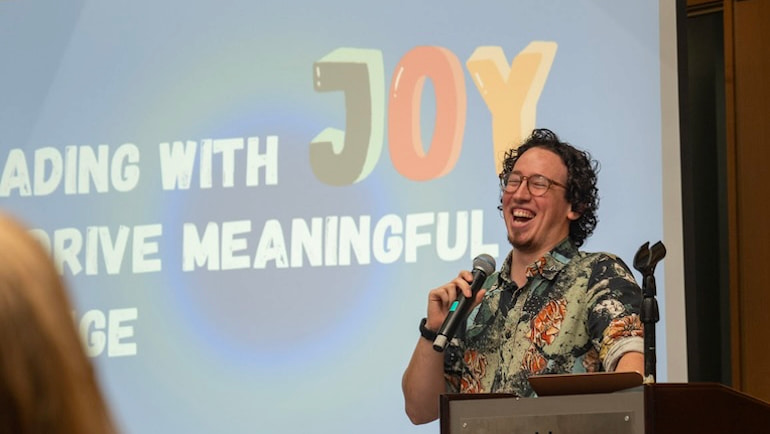
Ben Greene remembers a few moments that helped him realize how urgently his message of transgender joy is needed.
“I used to tell this dark personal story about the most difficult day of my life,” he remembers. “People loved it,” says Greene, a public speaker and author. But gradually, he realized telling the intense story over and over took a toll on him mentally and emotionally.
Then one day a woman asked Greene, casually, “What’s the worst thing that’s ever happened to you?” “I had this real moment,” Greene said.
He realized it was “normal” for most to view transgender people as miserable, anxious, depressed, or suffering. “I realized it did not occur to me or most people around me that I would have a good life.”
It’s one of many reasons why he adjusted his message – and why it’s now all about the joy and hopefulness of being a transgender person.
Greene calls himself the “transgender Mr. Rogers” and is committed to encouraging practical joy, and countering hopelessness.
“People are very hungry for hope,” says Greene. “They just don’t know where to go to look for it.”

Ben Greene, public speaker and transgender joy activist, signs his new book, “My Child is Trans; Now What?”
Greene will have public talks Sunday in Mount Pleasant, Iowa City
Greene, author of a new book geared toward parents of kids who identify as transgender, shares his message through speeches across the country – like the two he’ll be giving Sunday in Iowa.
Greene speaks at The Belle Center in Mount Pleasant at 1:30 p.m., and at Prairie Lights Bookstore in Iowa City at 4:30 p.m.
He first “came out” as bisexual at age 15, realized he was transgender at age 17, and physically transitioned in several steps about five years later. His experience as a transgender person is a generally positive one, with a mostly positive and outgoing childhood prior to his transition, an accepting family (including two younger sisters) once he began to transition, and a hometown in Connecticut that either refrained from criticizing him, or outright embraced him.
Originally aspiring to become a teacher, Greene pivoted to public speaking and advocacy in 2019, after he gave a TED talk about being a transgender man. He’s married, and his new book, “My Child is Trans; Now What?” is receiving positive reviews. His talks are low on heart-wrenching moments and big on smiles.
Even without drama that pulls at heartstrings, Greene’s talks with people nationwide are magnetic, says a PFLAG official who’s watched him develop his outreach.
“He has this ability to really connect with the audience,” says Beth Gasparovic, who met and worked with Greene in her role as head of PFLAG Greater St. Louis. She says that youth and teens tend to treat him “like a rock star” after they’ve met him, and many regard him also as a respected “elder.”
“Even if a lot of folks may be uncomfortable with the topic, he reaches them. His humor, his silliness, is contagious, and it allows folks to connect with Ben as a whole person. He’s really careful about sharing all of who he is, and that he’s more than just his gender.”
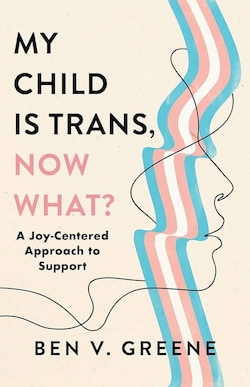
Ben Greene’s book, “My Child is Trans; Now What?” aims to help the families of transgender children understand how to find joy in the experience.
Greene’s message about cultivating hope transcends gender
Here’s one of the key foundations of Greene’s public talks: joy is a choice.
“Joy is not the same as happiness,” he says. “I really think of joy as a practice, and a choice. Happiness is circumstantial. Joy is contentment, empowerment, connection, and knowing I have the ability to affect change.
“Joy doesn’t mean that i know how things will go, or that I know everything’s going to work out just fine. Joy says ‘I have no choice but to try.’ “
Another key to Greene’s message: “Your despair is someone else’s business model.” He walks people through some truths about social media that are reinforced by things like last week’s court ruling holding Meta and Youtube liable for a young adult’s social media addiction.
“I point at the forces that are causing that hopelessness, like social media companies and legislation,” he says. “I’m willing to name everything people are afraid of, and show I’m hopeful in the face of that.”
“I help people know that the subset of news they’re hearing is not to keep them informed, but to keep them online,” he says. “And I help them see that if you go out in the real world, and you build community, and you meet real people, even those that you might not agree with right away, you will find so much more kindness than you’ve been led to believe is out there.”
Greene’s appeal as a public speaker is both an uplifting surprise to his parents, and something they’ve always expected. His father Matt is a financial advisor who has always done a lot of public speaking. The Connecticut school district that Greene attended as a child and teen had public speaking built into many aspects of its curriculum, says Greene’s mom Cathy.
Yet still, she says, “I’m kind of in awe of him all the time.
“At first, I thought, ‘Oh is this going to be the same kind of story over and over again?’ Boy, was i wrong. He brings this flexibility and fluidity to just about any topic. And the good humor he brings to all of it. I feel like he teaches us so much.”
In practice, it’s Greene’s own systems and awareness that help him be flexible and fluid with audiences on so many topics. Greene says he follow several key routines to help him follow through on practicing joy:
– He does not use social media apps on his phone.
– He limits himself to checking news feeds only twice a day, and for only 20 minutes.
– Half of that time online is devoted to positive news only.
– He prioritizes local news sources over corporate news sources.
Those steps together — along with being aware of his own body’s physical signs that he is headed toward mental or emotional stress — help Greene maintain a balanced outlook at a time when bathroom bills and transgender sports bans can create a sense of siege.
Greene also doesn’t want to minimize the pain of being transgender today, especially in communities where it can feel like the law or church institutions are “against you.”
“Joy doesn’t mean there is no room for fear, rage and grief,” he says. “They are powerful emotions that let us know when things cannot be accepted.
“But we cannot build a home in rage and grief. We can only build angry futures. I come home to joy as a choice.”
Greene’s talks on Sunday are courtesy of PFLAG Mount Pleasant. Earlier this week, Greene also spoke with PFLAG Chariton/Lucas County in central Iowa. He was also a keynote speaker for the Unique and United Conference Saturday in Ottumwa.
For the addresses of Greene’s talks in Iowa tomorrow, head to the PFLAG Mount Pleasant website. To learn more about Greene, head to his website, bgtranstalks.com.
(Photos courtesy of Ben Greene)