
Update: Incumbent Ruth Ann Gaines of District 33 announced a few days after this article that she would retire for family reasons rather than seek re-election. Watch for a story coming Dec. 16 outlining this and other political developments throughout Illinois and Iowa.
IOWA — The David Hogg effect has hit Iowa, with two young male challengers launching early campaigns to unseat older Democrats.
Adam Peters of Davenport and Cody Smith of Des Moines are both seeking to oust Democratic incumbents. If either or both succeeds, they’ll also achieve a historic distinction: to be the first-ever openly LGBTQ+ cisgender male to serve in the Iowa State Legislature.

Cody Smith, formerly the Democratic primary challenger of Ruth Ann Gaines in Des Moines’ Iowa House District 33 until Gaines dropped out Dec. 9; David Hogg, founder of the Leaders We Deserve PAC; and Adam Peters, Democratic primary challenger of Ken Croken in Davenport’s Iowa House District 97.
The two share a lot – campaign priorities, and their “poised to make history” identities. They also announced their campaigns early – in October, four months before they can officially file for the June primary election they both must win to face a non-Democrat opponent.
But they are also drastically different – in how they’re communicating their campaigns to the public, how they communicated with the Dems they’re challenging, and their relationships with the incumbents they’re challenging.
Let’s take a quick look at how the David Hogg effect is manifesting organically in Iowa. How are these two challengers handling their races? And what could their efforts to unseat fellow Democrats mean for Iowa, challenged identities, and the political process?
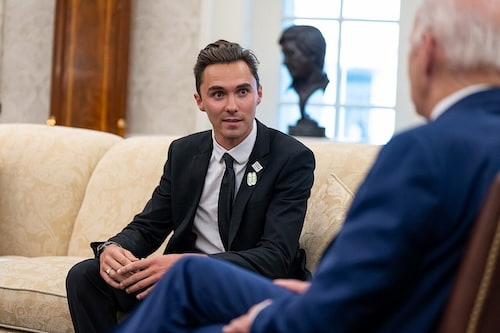
David Hogg: originally gun safety, now targeting fellow Democrats
Hogg (above, talking with former President Joe Biden in 2023) is founder of the “Leaders We Deserve” political action committee that announced earlier this year it would focus on primarying Democrats.
Hogg first gained fame as an outspoken survivor of the Parkland, Fl., school shootings in 2018. He pivoted from gun safety to taking out fellow Democrats last year and vowed earlier this year to raise and devote $20 million specifically to Democrats challenging Democrats in the U.S. House of Representatives.
Some experts place him in a category with New York’s AOC and Mamdani and other visibly youthful left candidates who rely heavily on social media, and are credited with injecting new hope into a left dominated by the right.
Others are concerned Hogg’s focus on youth and replacing fellow Democrats is a self-defeating force at a time when Republicans dominate the political landscape like never before. Hogg was, in fact, essentially forced out of national Democrat Party leadership because of his focus on Dems challenging Dems.
In Iowa, Hogg’s strategy — manifesting right now through Peters and Smith’s primary challenges to fellow Democrats — has uniquely high stakes.
Two-thirds of Iowa’s state legislators are Republicans, part of a trend that’s gripped Iowa since it helped launch Barack Obama to the presidency in 2008. In Iowa, Republicans have held a trifecta – control of both Houses and the governor’s office – for more than a decade.
So the strategy of “Democrats working to take out fellow Democrats” seems, on the surface, an odd use of resources.
Then, there is the reality that young Democrats taking out older Democrats means letting go of actual legislative experience and networks in favor of albeit youthful, performative energy with unknown, unproven impact in actual legislation.
Also, Iowa is in a phase where its Democratic legislators urgently need to focus on their jobs, to stem the continuous tide of growing red power. These primary challenges mean two of Iowa’s rare Democrats must instead pull away from legislating in the pivotal upcoming session to campaign against fellow Democrats.
On the other side … consider this dynamic: official party organizations are built to favor the incumbents already in the seat. No wonder those incumbents win overwhelmingly; statistics show that 90 percent of state legislative incumbents defeat their challengers. – and no wonder young challengers are able to ride waves of “no one owns this seat.”
Smith, for example, says he’s been refused access to the Iowa Democratic Party’s voter database system, which is filled with information and tools that help make campaigning, fundraising, and voter targeting more efficient and effective. Peters did not respond to requests for an interview to explore whether he has access to those tools, since he also serves as chair of the Iowa Democratic Party’s Stonewall Caucus, its official arm representing LGBTQ+ interests.
Regardless, the systemic problem of party organizations favoring incumbents over challengers is a problem in and of itself that has partially inspired Hogg’s movement and others like it.
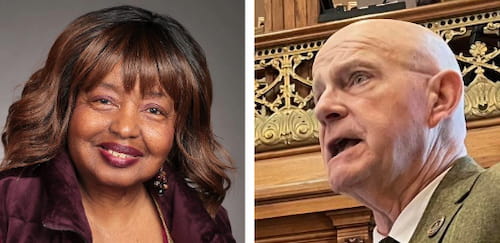
Ruth Ann Gaines, 14-year incumbent for Iowa House District 33 and facing primary challenger Cody Smith; and Ken Croken, four-year incumbent for Iowa House District 97 facing primary challenger Adam Peters
Smith, Peters take two different tactics to challenge their incumbents
Speaking of those incumbents, Peters and Smith have taken drastically different approaches to challenging their incumbents.
- How They Communicate With the Public About Their Campaigns: When Cody Smith announced he was challenging Democratic incumbent Ruth Ann Gaines (above left) for the central Iowa House seat, he included a key line in his opening announcements: “challenging an incumbent.” Peters’ announcement, by contrast, skipped that part and has consistently portrayed his candidacy as being against Republicans, and as pursuing an open seat, though current office-holder Ken Croken (above right) already scheduled a campaign launch that he cancelled to convert to a food drive. Unless Croken bows out, Peters will need to first defeat the fellow Democrat — also a former collaborator and a politician Peters supported himself as recently as last fall.
- How They Communicated With the Incumbents They’re Challenging: Smith said he informed Gaines he was exploring a primary challenge to her and met with her for four hours, “hoping she’d convince me not to run,” before announcing his primary challenge several days later. Peters did not return requests for interviews, but Croken says he received a voicemail from his young challenger the evening before Peters contacted the media to announce his candidacy.
- How They Are Connected to the Incumbents They’re Challenging: Smith knew seat-holder Gaines only in passing, over about six years of Smith working as a lobbyist and Gaines as a sitting legislator. By contrast, Peters is a friend, a former collaborator of Croken’s, and also served as Croken’s campaign surrogate just last fall, when Croken earned re-election to the Iowa House for his second term. The two collaborated as recently as September 2025 on a fundraising effort for Peters’ former employer, Clock Inc., and another prominent regional nonprofit, The Project of the Quad Cities.
- How Their Platforms Compare with the Fellow Democrats They Are Primarying: Smith’s platform and priorities are noticeably different than those of Gaines: she’s focused on public school funding, especially for kids with mental health and special needs, and addressing increasing layoffs and economic challenges facing farmers. Smith is focused on environmental issues including water quality, Iowa’s high cancer rates, enacting low-impact energy sources, and addressing LGBTQ+ issues like gender identity in the civil rights code. Peters and Croken have nearly identical platforms and histories: both are focused on protecting reproductive rights, committed to LGBTQ+ rights, ensuring public school funding addresses students’ needs, and increasing the minimum wage.
Possible Impacts for Iowa, Voters, Challenged Identities
These two races could affect Iowa in big ways beyond possibly netting the state its first openly LGBTQ+ cisgender male state legislator. Cis’ females achieved this honor seven years ago, by the way, when openly bisexual Sen. Liz Bennett first earned a state representative seat for the Cedar Rapids area.
Here are just a few of the possible largest impacts of these two primary challenges:
- Both Smith and Peters speak of reviving the fight to reinstate gender identity into the state’s Civil Rights Code, as among their top priorities. The topic already garnered out-sized media and activist focus for the past two years, setting records for protest sizes at the Iowa State Capitol. If the two young candidates make it through their primaries and defeat candidates from opposing parties, you can count on likely even bigger repeats of these issues. Whether that’s good news or bad news remains to be seen, based on activist tactics chosen and how that focus might affect Democratic priorities overall, including balancing out super-red states like Iowa.
- For Democrats in Iowa, who already face an uphill battle to offset more than a decade of ever-growing Republican dominance, these primary challenges mean increased pressure on their limited resources. Voters in these districts will be asked for two to five times more financial and volunteer resources, because many voters will be asked to fund at least one of the Democrats’ primary campaigns, plus their general election campaigns – and some may be asked for funding by both candidates in the primary race! This increased pressure on resources comes at a hard time for everyone: the country is on the verge of a recession, and both time and money are more needed than ever for day-to-day existence.
- In Des Moines, Smith’s election would give the largely LGBTQ+ East Village in Des Moines an LGBTQ+ state representative, something it’s never had despite being home to the Midwest’s oldest LGBTQ+ bar, many more historic LGBTQ+ bars, one of the few downtowns that still encourages LGBTQ+-themed rainbow crosswalks, and more explicit LGBTQ+ touches. It would also eliminate an incumbent who represents two other challenged identities: women, who are at their lowest point ever in Iowa House representation, and People of Color, notoriously under-represented in almost all spheres of Iowa government.
- In Davenport, where Peters and Croken are very similar as candidates except in age and public speaking approaches, voters are essentially being asked to swap out the old and some would say cold, for the young, warm and fuzzy. The trade would mean a closer match with the average age of Davenport residents: about 37 years old, which is 40 years younger than Croken and much closer to Peters’ age. Otherwise it’s pretty much a wash.
- Democrats hope these young challengers will help reinvigorate their historically unpopular party as it struggles to figure out how to effectively fight back against Trumpism and Republican dominance. Almost word for word, Democrats interviewed for these pieces referenced a desire for “increasing voter turnout.”
But even apart from these political, party-related questions, these races raise touchier human questions that no one seems to be asking. So I am:
- Is it good for voters’ mental health to put them into “campaign mode” four months earlier than needed – i.e., announcing these primary challenges four months before the first opportunity to actually file for those primary races, in February?
- Have we allowed political activism and frustration with incumbents to flirt with ageism, elevating “energy,” identity and speaking ability above experience and actual legislative impact and/or intersectional representation?
- Are we blaming incumbents for what is actually a failure of Iowa’s Democratic Party apparatus to effectively reach the voters they need to reach?
- And by focusing on replacing older Democrats, will Iowa find itself in the spot Harris eventually landed, that place of “sound and fury signifying nothing” – lots of great speeches, history made, but even fewer results at the ballot box that empower Democratic districts or taxpayers?
It’s been rough raising any of these questions. So many are so hungry to feel better, in this era of cruel Trump policies, that Democrats are impatient with self-examining questions about their own fairness and process. They’re painfully quick to judge calls for greater scrutiny as somehow “attacking” the candidates or institutions being scrutinized.
But these questions need to be asked – and now is better than later, especially with the early start of the 2026 Iowa state campaign season triggered by these two primary challenges filed so early.
Strangely, several Democrats I contacted about this piece referenced Joe Biden. It became clear that along with the David Hogg effect regarding youth, there is a Joe Biden effect regarding aging.
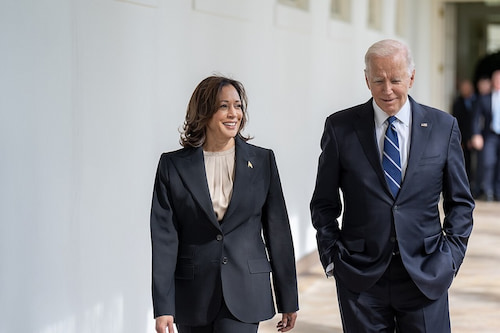
It’s true that Biden demonstrated the importance of older political candidates knowing when to bow out. Yet, it’s also true that through Kamala Harris, we learned that warm fuzzies, a cool vibe, and emotional speeches also won’t do the job alone.
Are Iowa’s Democrats applying the lessons of Hogg, Biden and Harris in the right measure ? Or are they essentially dancing with the devil, skipping over some key questions in the rush to go all-in for the young, hoping it’s the key to increasing voter turnout and reversing their party’s growing UNpopularity?
As MainStream expands our focus on political coverage in 2026, these two races are among those we’re watching to find out.
Reporter Caleb Sneeden contributed to this report.