
Check out This Date in History for Dec. 30, in MainStream’s daily look at significant progressive, intersectional historical events.
1609: The woman known as the most prolific female serial killer in history is arrested. Elizabeth Bathory is thought to have killed 600 young women over 30 years, after growing up in a world of both luxury and violence, and being schooled in torture by her first husband. Though some historians question whether Bathory was framed by leaders who felt threatened by her, most agree she was at minimum a sadist.
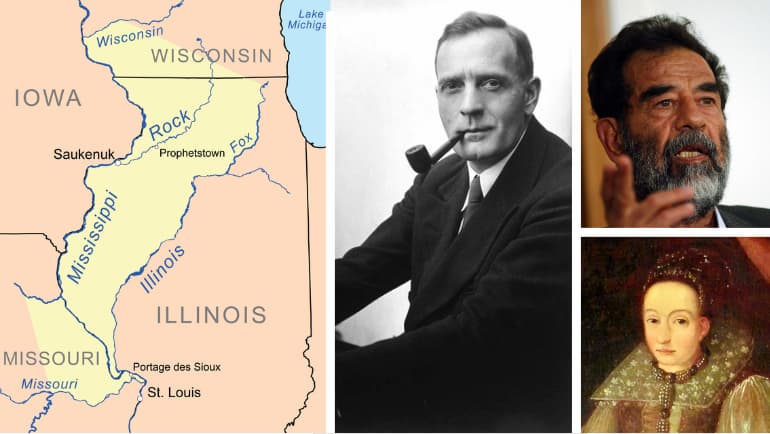
The territory ceded by three Native American tribes for $1,000 in the Treaty of St. Louis; astronomer Edwin Hubble; former Iraqi leader Saddam Hussein; and medieval serial killer Elizabeth Bathory.
1816: Three Native American tribes cede all of their land around the Illinois and Milwaukee rivers, and the Chicago canal, to the U.S. government for $1,000 ($23,000 in modern-day money). The Treaty of St. Louis involved the Ottawa, Ojibwa, and Potawatomi tribes and furthered white settlers dominance over the Midwest. “Many of the chiefs and warriors signed the treaty with an ‘X;’ one wonders whether they fully understood what the treaty would mean, given that they were told they could continue to hunt and fish there forever,” writes the Digital Research Library of Illinois History.
1903: The most deadly theatre fire in American history kills more than 600 people, mostly women and children, in Chicago’s Iroquois Theatre. The fire started when a spot of canvas brushed across a stage light. The victims were among 1,900 people who had packed the Theatre to see the musical comedy “Mr. Bluebeard.” The fire triggered the city of Chicago to require all theaters to have doors that open outwards, exits clearly marked, fire curtains made of steel, and fire drill practice for ushers and theater employees.
1922: The Soviet Union forms, a network of small states that had separated from the Russian Empire. More than 2,200 delegates came together in Moscow for the signing of the Treaty on the Creation of the Union of Soviet Socialist Republics, which essentially committed the new union to the Communist Party. The Soviet Union would dissolve 69 years later in 1991.
1924: Astronomer Edwin Hubble announces to the American Astronomical Society that he has discovered the Andromeda galaxy, and that the Milky Way is one of many galaxies.
Iraqis celebrate the execution of Saddam Hussein in 2006.
1941: Rep. Edith Nourse Rogers introduces a bill to form the Women’s Army Corps, allowing women to serve in some roles in the military for the first time.
1975: Minneapolis, Minn., becomes the first U.S. city to provide civil rights protections to transgender people.
2006: Overthrown dictator Saddam Hussein is executed for crimes against humanity, found guilty of ordering the killings of 148 Iraqi Shi’ite civilians after an assassination attempt. Hussein was captured in October 2023, imprisoned for three years, and tried for a year.
2024: An Appeals court upholds a civil case against President Donald Trump, holding him liable for assaulting journalist E. Jean Carroll and ordering him to pay $5 million in damages. The judge’s panel ruled Trump had failed to provide any flaw in teh orignal verdict. In a separate civil defamation case, Trump was also ordered to pay Carroll $83 million in damages.
Photos courtesy Wikimedia Commons.