
Check out This Date in History for Jan. 12, in MainStream’s daily look at significant progressive, intersectional historical events.
1773: America’s first-ever public museum opens in Charleston, S.C. The Charleston Museum was originally founded to showcase “natural productions, ancient remains, and other matters of public curiosity.” It continues to operate today, featuring millions of exhibits that explore “natural history, social history, decorative arts, and archaeological finds.”
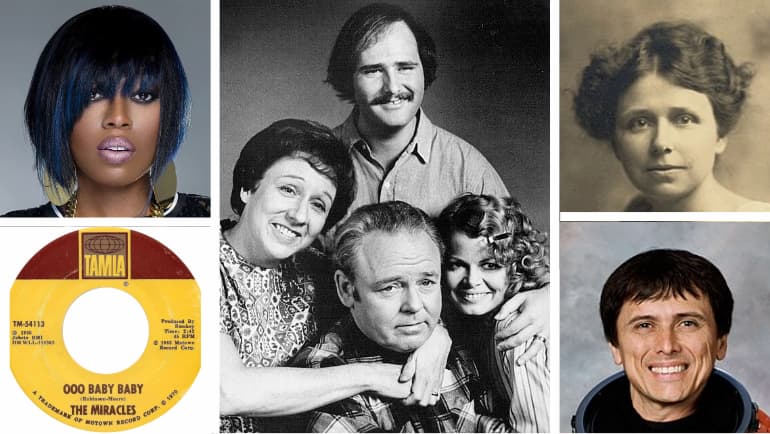
Clockwise from top left: rapper Missy Elliott, the cast of “All In the Family;” Hattie Wyatt Caraway; Franklin Chang Diaz, and an early release by Tamla Records, which would become Motown Records.
1932: Hattie Wyatt Caraway (D-Arkansas) becomes the first woman elected to the U.S. Senate. The former schoolteacher first was appointed to succeed her husband, who died while in office. Caraway won a special election for the seat six weeks later. She also became the first woman to chair a Senate committee and preside over the Senate.
1948: The U.S. Supreme Court rules in Sipuel v. Board of Regents of University of Oklahoma that state law schools cannot discriminate against applicants because of their race. Despite the ruling, Ada Lois Sipuel had to sit in a chair marked “colored,” was separated from the rest of the class by a barrier, and had to eat in a separate area of the cafeteria. She went on to graduate, practice law in Chickasha, Okl., and become a member of the Board of Regents of the University of Oklahoma.
1954: America’s policy of “massive retaliation” is announced by then Secretary of Defense John Dulles, who proclaims that attacks on American sovereignty will be met with atomic weapons instead of conventional weapons. The speech, intended to discourage Soviet aggression, is thought to heighten nuclear proliferation in the coming decade.
1959: What would become Motown Records begins, when Berry Gordy Jr. founds Tamla Records in Detroit, Mich., with the help of an $800 loan from his family. Gordy focused on attracting Black artists whose “tunes, lyrics and audio effects” would appeal to both Black and white listeners.
1967: Dr. James Bedford receives his wish to be cryonically preserved within minutes of passing away, becoming the first human to be stored in a frozen state. His body remains in storage today in Emeryville, Calif.
Above, “All in the Family” starring the late Rob Reiner as Michael, the liberal son-in-law, premiered Jan. 12, 1971.
1971: “All in the Family,” the TV series that broke ground by showing racial tension within a family (and also an on-air toilet flush), premiers on CBS. Called “America’s first reality show” because of how it addressed real-life family differences, the show starred the late Rob Reiner as the liberal son-in-law, Carroll O’Connor as the bigoted father, Jean Stapleton as the mom seeking to keep peace, and Sally Struthers as the daughter. It would run for 10 years.
1983: The first-ever tests to identify the virus that causes AIDS start. Within two weeks, those tests identify what is now called HIV (human immunodeficiency virus), and then called LAV (lymphadenopathy-associated virus).
1986: Franklin Chang Diaz is among the crew of the Space Shuttle Columbia and becomes the first-ever Hispanic astronaut in space.
2000: In a 5-4 decision, the U.S. Supreme Court rules that “nervous, evasive behavior and location in a high crime area are relevant factors in determining the reasonable suspicion necessary” for a legal stop by police. The case, Illinois v. Wardlow, involved a man who was stopped by police in an area known for drug trafficking after he ran from them.
2019: Missy Elliott becomes the first female rapper to be inducted into the Songwriter’s Hall of Fame. Elliott released her first solo album in 1997 and has extensive songwriting credits for artists that include Whitney Houston, Mary J. Blige, Aaliyah and Jennifer Hudson.
Photos courtesy Wikimedia Commons.