
Check out This Date in History for Jan. 13, in MainStream’s daily look at significant progressive, intersectional historical events.
1864: “The Long Walk” of the Navajo begins, when American Col. Kit Carson and his troops invade the Navajo Diné lands in Arizona and New Mexico; destroy crops, dwellings and livestock; and begin forcing 10,000 Dine people to march 300 miles to an internment camp hours away. The Diné people will be allowed to return to their homeland four years later, when the Navajo Treaty is signed and helps the Navajo become the largest remaining Native American tribe in the United States.
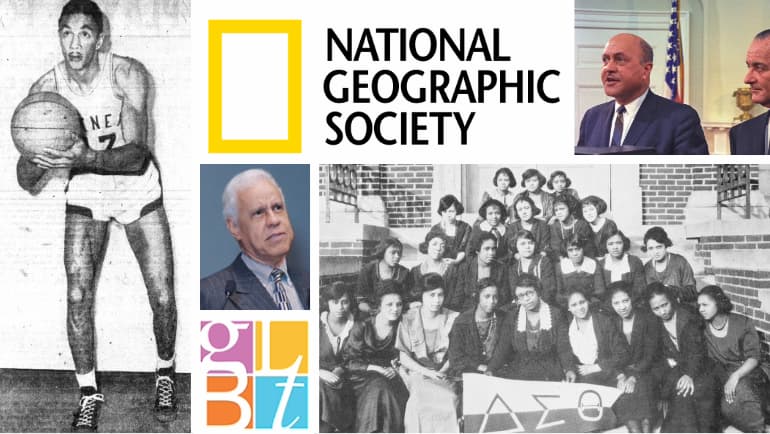
Clockwise from top left: basketball star Don Barksdale, the National Geographic Society logo, Robert C. WEaver, a class of the Delta Sigma Theta sorority; the logo of the GLBTQ History Museum and Archives; and former Virginia Gov. Douglas Wilder.
1888: The National Geographic Society is founded by a group of explorers and scientists. Created to promote knowledge of science, world cultures, and history, the Society publishes the first issue of its magazine later in the year, and now operates tv channels as well.
1913: What will become the world’s largest African-American Greek sorority forms, when Delta Sigma Theta forms at Howard University in Washington, D.C. The sorority replaces Alpha Kappa Alpha and places greater focus on civic service and political awareness. Delta Sigma Theta, open to all races, now has 1,000 chapters worldwide. and more than 350,000 members.
1953: Don Barksdale, a forward for the Baltimore Bullets, becomes the first Black player in an NBA All-Star game.
1958: In what is known as the first-ever pro-gay U.S. Supreme Court ruling, One Inc.’s article about two lovers is ruled not to be “obscene.” In One, Inc. v. Olesen, Editors of the magazine, targeted by the postal service and the government at a time when homosexuality was criminalized nationwide, sued the Los Angeles postmaster. The Supreme Court ruling overturned two lower courts’ decisions.
1966: Robert C. Weaver becomes the first-ever Black Cabinet secretary a, when President Lyndon B. Johnson appoints him as head of the new Department of Housing and Urban Development (HUD). Weaver first began civil service at age 27 under President Franklin Roosevelt, served under the Kennedy administration, and also formerly led the NAACP.
1972: Bernice Gera wins a sex discrimination lawsuit against Minor League Baseball to become the first female umpire. Despite previous experience as an umpire, her application was rejected, and she fought in the court system for three years. Despite the victory, due to sexism from other umpires, she resigns after her first game.
1986: The National Collegiate Athletics Association (NCAA) passes Proposition 48, setting minimum grades and test scores for college sports participants. Critics, including civil rights groups, say it will keep talented Black male athletes from college; over 80% of the athletes barred from teams over academics are Black. The NCAA amends its standards, but still requires minimum test scores for college athletics.
Above, a short film showing the 1992 first all-female team ever to compete in the America’s Cup yachting competition.
1990: Douglas Wilder becomes America’s first elected Black governor. He earned election to lead Virginia after previously serving as lieutenant covernor and a state legislator. He’d go on to become mayor of Richmond, Va., too.
1995: The America3 (America cubed) team competes in America’s Cup sailing competition and becomes the first all-woman team in the Cup’s 144-year history. Video above.
2011: The Gay Lesbian Bisexual Transgender (GLBT ) Historical Society Museum opens in San Francisco. With a companion museum already open in Berlin, the GLBT museum becomes America’s first standalone museum dedicated to queer history.
2021: Donald Trump becomes the first president to be impeached twice after the house votes to impeach him for incitement of insurrection, following the Jan 6. attack on the capitol by Trump supporters to prevent the certification of the 2020 election results. The Senate will acquit Trump in February.
Photos courtesy Wikimedia Commons.