
Check out This Date in History for January 25, in MainStream’s daily look at significant progressive, intersectional historical events.
1890: The group that laid the groundwork for Black civil rights, the National Afro-American League, is founded in Chicago by newspaper publisher and former slave Timothy Thomas Fortune. The group had tried to form three years earlier but hadn’t raised enough funds. During its eight-year history, the League would advocate for voting rights and equal rights in education and public accommodations for Blacks.
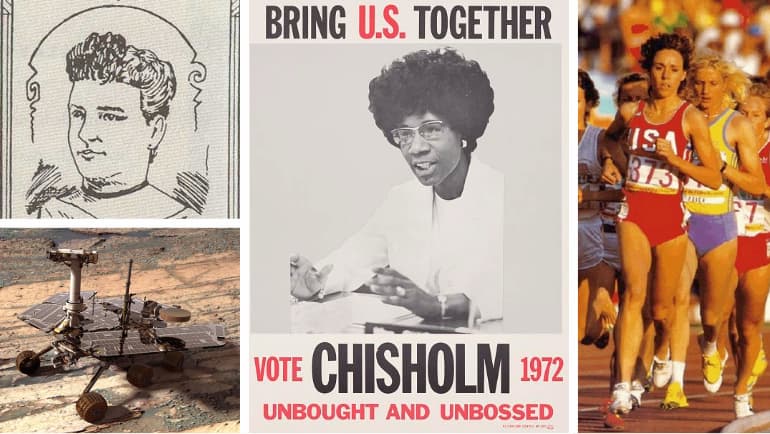
Left, killer Alice Mitchell and the Opportunity space rover. Center, a campaign poster for Shirley Chisholm. Left, record-breaking runner Mary Decker.
1892: In one of the earliest cases of falsely connecting homosexuality with mental illness, Alice Mitchell cuts the throat of her former girlfriend Freda Ward in front of a crowd. Mitchell claimed she killed Ward after Ward’s family forbade her to elope with Mitchell, who planned to live as a man. Mitchell’s attornies’ decision to plead insanity, plus a judge who enjoyed the large crowds, helped the case contribute to homosexuals being labelled for the next several decades as dangerous or mentally ill. The story about Mitchell’s attack was also “the first time the word ‘lesbian’ appeared in news print,” writes Elmwood Cemetery.
1919: A worldwide conference after World Word I agrees to found the League of Nations. Spearheaded by U.S. President Woodrow Wilson, the League’s purpose was to maintain world peace through disarmament and humanitarian efforts, and to help Europe recover from the ravages of the four-year war. Forty-four nations would join the league six months later, and it would meet for the first time the following January. The league would dissolve in 1946 after failing to prevent World War II.
1972: Shirley Chisholm becomes America’s first Black candidate for president. The former teacher and New York Congressperson was already the first-ever Black woman elected to Congress. She would not win the Democratic Party’s nomination, but she’d be remembered for eight terms in Congress during which she focused on righting police brutality and social injustice, and support for unions and LGBTQ+ rights.
1979: A robot kills a human for the first time, when 25-year-old auto factory worker Robert Williams of Flat Rock, Mich., is crushed instantly by a giant robot arm that likely mistook him for an extra part. At least 41 humans have been killed by robots, according to the National Institutes of Health.
1980: Mary Decker becomes the first woman to run a mile under four minutes and 20 seconds, clocking in at 4:17.55. She’ll go on to become a world champion in the 1,500 and 3,000 meter distances, also. Men had first run a mile under four minutes back in 1954; today, the women’s world record sits at 4:06 (set last year) while the men’s world record for a mile is 3:46.
2004: The space rover Opportunity lands on Mars, kicking off a 15-year run during which the rover would discover that Mars used to be continuously wet and could have harbored life. Opportunity was originally supposed to stay on Mars for only 90 days; it finally stopped transmitting information in 2018 after a windstorm covered it with Mars sand.
2019: New York state passes its landmark Gender Identity and Non-Discrimination Act (GENDA), which extended the state’s civil rights protections to transgender people on the basis of gender identity, and also banned “conversion therapy” (attempting to change one’s sexual orientation or gender identity) by licensed mental health professionals (but not religious entities). The legislation passed after being proposed for the previous 16 years but consistently defeated by Republican legislators.
Photos courtesy Wikimedia Commons.