
Check out This Date in History for January 27, in MainStream’s daily look at significant progressive, intersectional historical events.
1785: America receives its first university chartered by a state government when the University of Georgia opens in Athens, Ga. Earlier universities in the young America had been chartered by the British Monarchy. Today, the University of Georgia has 40,000 students.
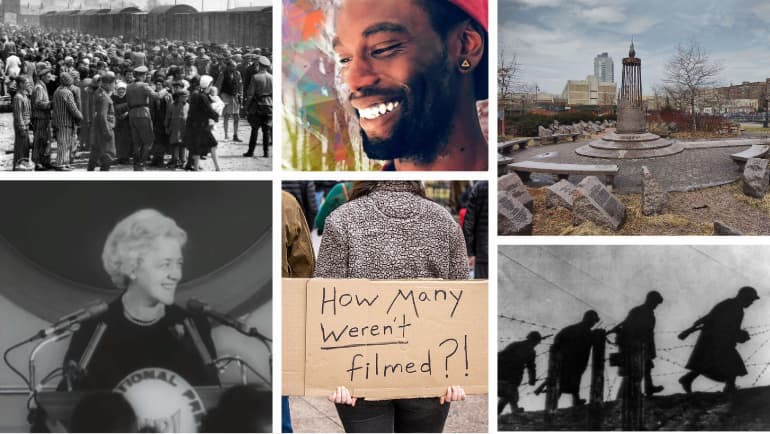
Clockwise from top left: crowds of prisoners at Auschwitz; Tyre Nichols; the Holocaust Memorial; Soviet soldiers fighting Nazis in Leningrad; a protest sign on behalf of Tyre Nichols; and Margaret Chase Smith.
1825: President James Monroe presses his “removal” policy to Congress of relocate Native Americans to reservations west of the Mississippi River. Legal battles delay the Indian removal, but five years later President Andrew Jackson displaces over 60,000 people, including 8,000 who die on the “Trail of Tears” forced march.
1847: The Crosswhite family and 100 of their neighbors help inspire the future Fugitive Slave Act that will protect escaped slaves from prosecution. The family from Marshall, Mich., escaped their slave owner, and their neighbors helped them reach Ontario, Can., by train. The family will return to Marshall after the Civil War.
1917: After almost five days without food, women’s rights activist Ethel Byrne, sister of Planned Parenthood founder Margaret Sanger, becomes the first-female American prisoner to be force fed. Jailers at Blackwell’s Island in New York City wrap her tightly in a blanket and force milk, eggs and brandy through a rubber tube. Byrne was serving a 30-day prison sentence for sharing information about contraceptives.
1944: The Nazis retreat from the Siege of Leningrad, the most destructive and deadly siege in world history. Over two years and four months, Nazis kill an estimated 1.3 to 2 million residents of the Soviet city while pursuing its Jewish residents. Despite the incredible loss of life, Leningrad becomes a symbol of Nazi resistance, and the end of this long siege becomes a turning point in World War II.
1945: The Auschwitz concentration camp, the worst and deadliest concentration camp where over 1 million people lost their lives, is liberated by Soviet soldiers. Over 7,000 people are saved, most having been forced on a death march to Dachau days before. The Soviet soldiers are documented to be shocked by the camp’s barbaric conditions.
1964: Sen. Margaret Chase Smith, R-Maine, announces she’s running for president. She’ll become the first woman nominated for president at a major party convention, but Barry Goldwater wins the candidacy. Smith will also become the first woman to serve in both houses of Congress.
1973: The Paris Peace Accords end Western intervention in the Vietnam War after over 17 years. North and South Vietnam quickly break the agreement, and their war will continue until 1975 when North Vietnam will prevail.
Protests broke out nationwide in January 2023 when bodycam video of the fatal police beating of Memphis resident Tyre Nichols is released.
1983: French researchers discover HIV (human immuno-deficiency virus), the retrovirus that causes AIDS, through an experiment on a lymph node sample from a patient showing symptoms of AIDS. Françoise Barré-Sinoussi and Luc Montagnier will eventually share credit for discovering the cause of AIDS with Robert Gallo, an American researcher whose research was also ongoing and who would announce a similar discovery a few months later. The French team originally call the virus Lymphadenopathy-Associated Virus (LAV).
1992: Years before President Bill Clinton lies to the nation about having an affair with an intern 27 years his junior, cabaret singer Gennifer Flowers accuses presidential candidate Clinton of a 12-year affair. Clinton will deny Flowers’ statements for years, then finally acknowledge the affair under oath in 1998while being investigated for his affair with intern Monica Lewinsky.
1996: More than years after the liberation of Auschwitz, Germany begins a yearly remembrance for the 6 million Jewish victims of the Holocaust. The United Nations will adopt the day as International Holocaust Memorial Day ten years later.
2017: The Trump administration tries to ban immigration from seven Muslim-majority countries for 90 days. The order affects Syria, Iran, Iraq, Libya, Somalia, Sudan, and Yemen and also pauses refugee admission for 120 days. While the order is struck down by courts twice, a modified version is upheld by the Supreme Court remains in place until Trump leaves office the first time in 2021.
2022: Biden pledges to nominate a Black woman to the Supreme Court after Justice Stephen Breyer announces his retirement following 28 years of service. The announcement triggers criticism from conservatives accusing Biden of choosing identity over qualifications. In February, he’ll nominate Ketanji Brown Jackson, a judge in Wash., D.C., who will be approved and become the first and so far only Black woman to serve on the Supreme Court.
2023: Protests erupt after video is released of the police killing of Tyre Nichols, a Memphis man stopped for reckless driving the night of Jan. 7 and killed by a group of officers who beat him for three minutes. Four of the officers will be convicted on various charges for the murder.
2025: Newly inaugurated President Donald Trump signs an executive order banning transgender people from military service. The ban is being challenged in court. In May, the U.S. Supreme Court ruled without comment that the ban would stay in effect, rather than be withheld, while the court challenge proceeds.
Photos courtesy Wikimedia Commons. Tyre Nichols protest photo courtesy Becker1999. Christine Hawes contributed to this report.