
Check out This Date in History for Jan. 4, in MainStream’s daily look at significant progressive, intersectional historical events.
1847: Samuel Colt sells 1,000 Colt revolver pistols to the U.S. government, just as he was about to become poverty-stricken. The Colt revolver drastically improved the accuracy and speed of previous revolvers and gave the United States an edge in the Mexican-American War.
1884: The Fabian Society is founded in London, England to advocate for a democratic socialist state in Great Britain, and promote equality, citizenship, and human rights. It was instrumental in influencing Britain’s Labour Party, to which former Prime Minister Tony Blair and current Prime Minister Keir Starmer belong.
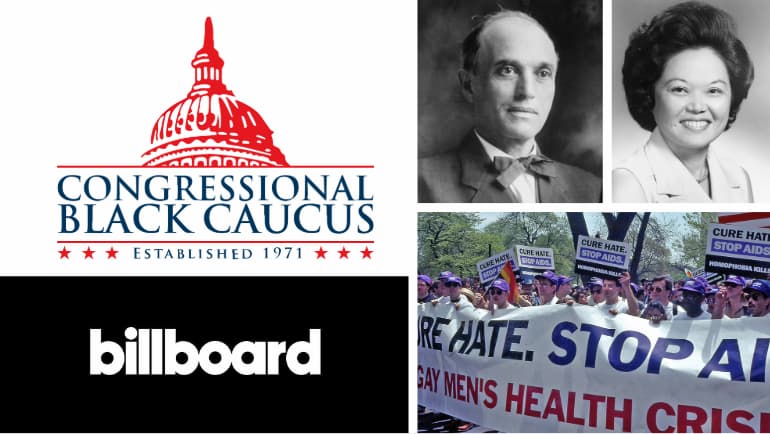
From top left: the Congressional Black Caucus, former Idaho governor Moses Alexander, former U.S. Rep. Patsy Mink; the Gay Men’s Health Crisis; and Billboard Magazine’s logo.
1904: Puerto Ricans cannot be refused admission onto the American mainland, a judge decides in Gonzales v Williams. The case involved a young Puerto Rican woman initially turned away at Ellis Island, declared “immoral” because she was pregnant and traveling alone. Puerto Ricans would not receive full citizenship rights until 1917.
1915: America has its first-ever elected Jewish governor when Moses Alexander becomes governor of Idaho. Alexander served two terms and helped build the state’s highway system and its farm market bureau, and supported the suffragette movement for women’s right to vote.
1925: French psychologist and hypnotist Emil Coué helps self-esteem therapy get a boost in America. He advocates what becomes known as Couéism: positive thinking to achieve health. He taught his followers to repeat this phrase: “Every day in every way I am getting better and better.”
1936: The first-ever chart of music sales begins from Billboard Magazine. Created 42 years after Billboard first began publishing, the list would be joined in less than 20 years by Billboard’s Hot 100 of top-selling songs.
1965: Patsy Mink of Hawaii, who would go on to author the Title IX legislation requiring gender equity in public education, becomes the first-ever woman of color in Congress. Mink would serve six terms in the U.S. House and later become Assistant Secretary of State for Oceans and International Environmental and Scientific Affairs under President Jimmy Carter.
Nancy Pelosi becomes the first-ever female Speaker of the House in 2007
1969: What would become the Congressional Black Caucus is founded, featuring people who would go on to become leaders in government and the civil rights movement. Among the members of the caucus, originally called the Democratic Select Committee, were Shirley Chisholm (first Black woman to run for president), John Conyers (the longest-serving Black Congressperson), and Charles B. Rangel (first Black legislator to serve as chair of the House Ways and Means Committee).
1974: U.S. President Richard Nixon refuses to hand over tapes he had made of presidential conversations that were subpoenaed by the Watergate Committee as it investigates the Watergate break-in. His refusal leads to three impeachments and Nixon’s resignation eight months later.
1982: Larry Kramer and five others start the Gay Men’s Health Crisis in Kramer’s New York living room after hearing of a mysterious affliction claiming the lives of gay men in New York and San Francisco. Soon, the organization would also serve drug users, People of Color, and the impoverished. It continues to exist today, fielding 5,000 calls a day to its hotline and helping tens of thousands of people each year live with HIV.
2007: Nancy Pelosi of San Francisco becomes the first -ever female Speaker of the U.S. House of Representatives a post she’ll hold for the next 18 years to accolades and praise.
2010: Almost three decades after AIDS is first identified in the United States, HIV infection is removed from the list of conditions for which immigrants can be blocked from entering the country.
2024: Donald Trump, previously banned from the state of Colorado’s presidential ballot because of the January 6 insurrection, asks the U.S. Supreme Court to overrule Colorado’s December 2023 decision. The high court would rule in Trump’s favor two months later, declaring that individual states don’t have the constitutional authority to remove candidates from the presidential ballot.
Photos courtesy Wikimedia Commons.