
Check out This Date in History for March 4, in MainStream’s daily look at significant progressive, intersectional historical events.
1789: The United States government convenes under the rule of the U.S. Constitution, for the first time since the Constitution was passed almost two years earlier. Only about one-fourth of Congress members arrive on time in New York City, where the Legislature meets until moving to Washington, D.C., in 1790.
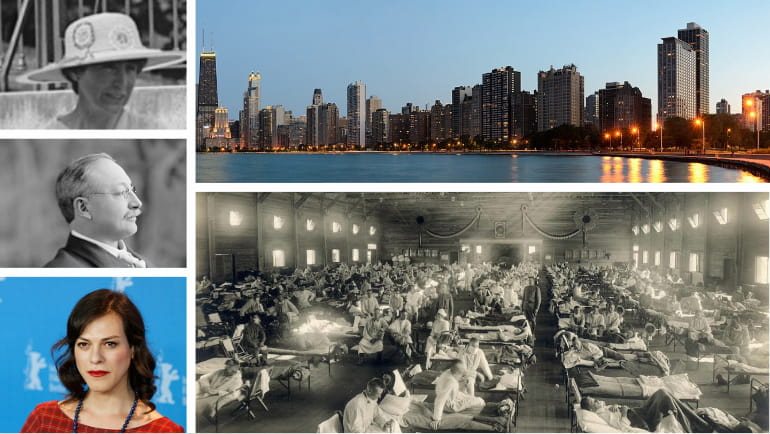
Clockwise from top right: Jeanette Rankin, the Chicago shoreline and skyline, an emergency barracks for “Spanish flu” patients in the early 1900s, Daniela Vega, and Victor Berger.
1837: The Village of Chicago is incorporated as a city, with a population of 4,000. Founded as a military post, Chicago quickly becomes an industrial hub and center of trade. It will also become one of the world’s fastest-growing cities and now has a population of 2.7 million.
1911: The first-ever Socialist to serve in the U.S. Congress takes office; newspaper publisher Victor Berger was elected to represent Wisconsin. He’ll go on to run several times, and win several times, at one time proposing to eliminate the U.S. Senate altogether.
1917: Jeanette Rankin of Montana becomes the first-ever female U.S. Representative, three years before women gain the right to vote nationwide. She’ll also help co-found the American Civil Liberties Union (ACLU) in 1920. She returns to office in 1940 and is the only legislator vote against the United States’ participation in both World War I and World War II.
1918: The first cases of the so-called “Spanish flu” are reported at an Army camp in Kansas. Within weeks, 1,000 are infected, and soldiers traveling across the world will spread the virus throughout the Midwest and eventually to Europe. The virus was falsely labelled the “Spanish flu” because Spain was the only country that reported openly on the epidemic, while other countries suppressed information as a means to bolster morale during World War I. The virus will eventually kill 600,000 Americans and up to 25 million people worldwide by 1920.
1933: Frances Perkins becomes the first female cabinet member, appointed by U.S. President Franklin Delano Roosevelt as the Secretary of Labor. She’ll go on to develop Social Security policy and will serve 12 years, the longest term for a Secretary of Labor. Perkins will also advocate for women to fill jobs traditionally held by men and will lobby for immigrant workers rights.
1936: The Hindenburg takes its first-ever voyage in Germany, kicking off a one-year “era of the airship” that ends about a year later when the giant balloon bursts into flames above New Jersey while in flight, killing 35 of the 90 crew and passengers on board.
Above, the U.S. Supreme Court rules in early 2024 that only Congress, not states, can decide who is qualified to run for President. The high court was ruling on an effort by three states, including Illinois, to remove Trump from its ballot.
1974: People Magazine begins publication, a creation of the same company that created TIME Magazine. People will focus on individual stories instead of news and outpace its parent magazine in circulation. Today, it sells 2.2 million magazines a year.
1983: The Centers for Disease Control (CDC) publishes its first guidelines on preventing HIV, recommending no sexual contact with HIV/AIDS patients, a recommendation against those at high risk from donating plasma or blood, and safer products for hemophilia patients. The article also suggests HIV may spread by bodily fluids, something not commonly known at the time.
1998: Same-sex sexual harassment is ruled illegal like opposite-sex harassment by the Supreme Court in Oncale v. Sundowner Offshore Services, Inc. Joseph Oncale, a male oil rig employee claimed he was sexually harassed by male coworkers, but same-sex harassment wasn’t covered by the Civil Rights Act before this ruling.
2004: Mianne Bagger is the first transgender woman to compete in women’s golf, playing in the Women’s Australian Open. Bagger began transitioning in 1992, and became a professional golfer after winning several amateur competitions. She remained a professional golfer for several years, and helped convince the Ladies Professional Golf Association to change their rules to allow transgender women.
2018: Daniela Vega is the first transgender person to present an Oscar award. Vega is a Chilean actress and singer who transitioned before beginning her career.
2024: The Supreme Court rules states can’t block Trump from ballots. Colorado, Maine and Illinois struck Trump from Republican primary ballots for inciting an insurrection on Jan. 6, 2021, citing a section of the Constitution that says people who have “engaged in insurrection or rebellion” can’t be federal officeholders. The Supreme Court says deciding who is qualified to hold federal office can only be decided by Congress, not states.
Photos courtesy Wikimedia Commons.