
Check out This Date in History for March 5, in MainStream’s daily look at significant progressive, intersectional historical events.
1558: Tobacco is introduced to Europe from Mexico by a Spanish physician, who initially presents it as a “cure-all” that can help heal 20 maladies including cancer. Within 50 years, King James I would seek to limit the use of tobacco because of concerns over its damage to lungs and addictive qualities.
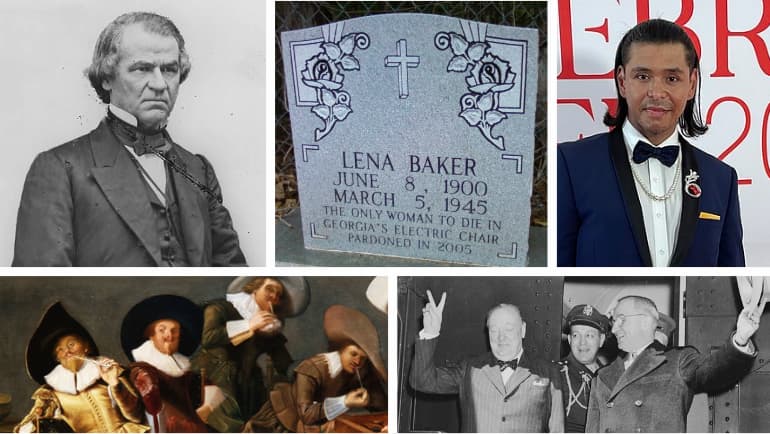
Clockwise from top left: former U.S. President Andrew Johnson; the gravestone of the late Lena Baker; cured HIV patient Adam Castillejo; former U.S. President Harry Truman traveling with Winston Churchill; and 1600s gentlemen smoking tobacco.
1770: Six years before the American Revolution, tension between the American colonies and the British military escalates with the so-called “Boston Massacre.” Nine British troops who are among 1,000 stationed in Boston to enforce tax collection are taunted and assaulted by a crowd of colonists, when a series of confusions causes one British soldier to begin firing on the colonists. Five are killed, including Black slave Crispus Attucks. The incident helps fuel the colonists’ uprising against the British that will eventually result in the Revolutionary War that starts in April 1775.
1831: The sovereign rights of Native American people are dealt a lasting blow when the U.S. Supreme Court rules in Cherokee Nation vs. Georgia that Native American tribes do not have “standing” to go before the high court. The ruling is considered the foundation of modern-day American policy toward Native Americans, labelling them “domestic dependent nations.” The ruling sets the stage for the forced removal of the Cherokee nation from Georgia, and other Native American removals throughout the country.
1858: Black abolitionists in Boston start “Crispus Attucks Day” as a protest against the U.S. Supreme Court’s Dredd Scott decision in 1857 that proclaimed Blacks cannot be United States citizens. Attucks was among five Americans killed almost a century earlier by British troops in the Boston Massacre and had become a symbol of martyrdom and freedom among both Blacks and whites since the incident.
1868: The first-ever impeachment trial in the U.S. Senate of a United States president begins, when Andrew Johnson is put on trial after already being impeached by the U.S. House of Representatives for his opposition to rights for freed slaves and his unilateral firing and replacement of a pro-Reconstruction secretary of war with Ulysses S. Grant, future president. Though the Senate votes twice to impeach him and a majority vote in favor each time, neither vote reaches the two-thirds threshold required.
1897: The American Negro Academy, the first scholarly organization for Black Americans, is founded. It grows to include many Black leaders such as W.E.B Du Bois and Kelly Miller, the first Black student at Johns Hopkins University, before dissolving in 1928.
1923: The first old-age pension laws are passed in Montana and Nevada, with pensions for retirees are established nationwide in 1935 through the Social Security Act.
Above, advocates speak out last March against the National Park Service’s removal of references to T and Q, and profiles of Marsha P. Johnson and Sylvia Rivera, from its websites.
1933: The Nazi party wins a plurality in the German national elections, setting the stage for Adolf Hitler’s reign of terror that will lead to the Holocaust and the extermination of 6 million Jews, homosexuals, transgender people and more. The Nazi win was helped by a fire set in German parliament a few days before the election, enabling the party to proclaim emergency powers.
1945: Lena Baker, a Black woman convicted in one day by an all-white, all-male jury, is executed by electrocution. Her state-sanctioned killing will be Georgia’s only executiion, ever of a woman, and will inspire a reform of Georgia’s prison laws and conditions. Baker will be pardoned posthumously 60 years later for killing her white boss after he locked in a gristmill and tried to assault her.
1946: The basis for the North Atlantic Treaty Organization (NATO) is laid when Winston Churchill gives his historic “Iron Curtain” speech, triggering the “Cold War” between European countries dominated by the Soviet Union and its nuclear ambitions, and the rest of the world. The speech, given at the invitation of U.S. President Harry Truman, is considered the inspiration for the Truman Doctrine that unites all countries that value democracy to aid each other in its defense.
2014: The largest-ever survey on violence against women takes place in the European Union, revealing that a third of women there have experienced physical or sexual violence. Conducted by the Agency for Fundamental Rights (FRA), the survey interviewed 42,000 women and still takes place annually.
2019: Adam Castillejo goes public with his status as the second person in history to be cured of HIV after a stem cell transplant. Castillejo received the transplant in 2016, but researchers waited to make sure he remained HIV-free before announcing that he’s cured.
2025: The U.S. National Park Service removes pages on its website formerly dedicated to transgender cultural heroes Sylvia Rivera and Marsha P. Johnson, as part of the Trump administration’s wholesale erasure of transgender topics from government websites. The removals came a few weeks after the T and Q letters are also removed from a webpage about the Stonewall Monument that honors the 1969 uprising of LGBTQ+ people against police brutality in New York City.
Photos courtesy Wikimedia Commons. Christine Hawes contributed to this report.