
We should be cooperating instead of competing. Like the vegetables.
Robin Wall Kimmerer, a Potawatomi professor, describes this concept in Braiding Sweetgrass, her personal memoir and nonfiction blended book of indigenous wisdom and scientific knowledge.
Kimmerer explains how corn, beans, and squash used to be grown together. And how each crop takes only what it’s given and needs. How these crops don’t compete for resources, nutrients and the sun.
Instead, the corn can grow tall, which provides stability for the beans. As they extend up the cornstalk, the beans provide shade for the squash. All of the vegetables gain the nutrients they need through the soil they share.
I chose to review Braiding Sweetgrass in the spirit of the multiple upcoming holidays. This book speaks on what the holidays are all about: gratitude and reciprocity, the idea of a gift economy, and other lessons of community.
Looking beyond Western capitalism
Expanding past conventional Western ideas, Kimmerer brings new perspectives to a world we think we already know. Braiding Sweetgrass inspires you to learn more from just the people around you.
Kimmerer’s main lesson stems from the ideas of gratitude and reciprocity. When we receive a gift, we’re thankful. Yet, gifts come with the responsibility to give back.
And in that way, “gratitude plants the seed of abundance,” Kimmerer writes. We are thankful for what we’re given; we want to give back. So we give what we’re able, and take what we need. Kimmerer presents the entire concept of reciprocity as the question of, “What can I put out into the universe? What can I give, as I have taken?“
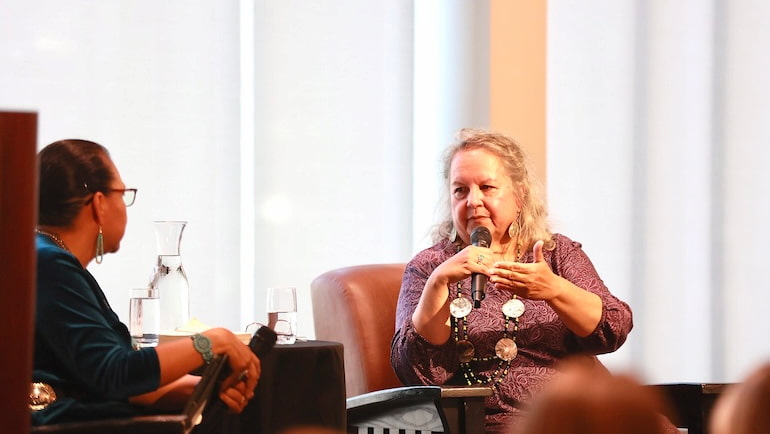
Robin Wall Kimmerer, right, speaks during an interview at the University of Indiana. (photo courtesy Indiana Humanities)
With this mutual understanding, that we’ll all give when we can and take when we need, we’re trusting each other. We’re building a mutual covenant, which can change our perspective on our own capitalist economy.
Kimmerer questions how a gift relationship is different than capitalist relationships. What if we all gave when we can, and added to mutual abundance? And then, in times of need, took what we need?
This viewpoint allows us to lean on each other and to support one another.
A call to redefine wealth
Kimmerer also challenges us to reframe the concept of wealth. What if it meant not how much you have, but “having enough to give away”? She poses bluntly how we believe that “belongings will fill our hunger, but it is belonging that is what we crave.”
She shows us that to truly help ourselves, we must help others too.
Kimmerer also asks us to consider what community means to us. In our hyper-individualistic society, we continually seem to be struggling, she writes. We’re taught to live independently, pull ourselves up by our bootstraps, and work harder.
To have a community, we must be the community, Kimmerer explains. We need to give, of even the smallest things. It doesn’t have to be earth-shattering; what may seem small to you, may change the world for someone else.
She offers many more lessons in Braiding Sweetgrass, with her simple, genuine take on the world and how we can treat, respect, and love the people around us.
At 400 pages, Braiding Sweetgrass can also be intimidating. If you’re looking for something more attainable, check out Kimmerer’s other book, The Serviceberry: Abundance and Reciprocity in the Natural World. It’s shorter but has just as many valuable lessons, thoughts, and take-aways.
I hope this review helps you ponder what gifts you can give, how you can show reciprocity, and how you’ll engage with your community and the world around you.
This article originally appeared in the December 2025/January 2026 edition of MainStream Magazine. Order home delivery, or find locations where you can grab a free copy.