QUAD CITIES — An announcement in July by Clock Inc. that it was in emergency “dire financial straits” with “nothing left to cut” and may close its doors in August has triggered a spreading wave of high profile media stories, new fundraisers, and social media posts.
They’ve all mentioned a crisis the Quad Cities nonprofit has said repeatedly is due to a drop in grant awards, increased costs, and the blatantly anti-LGBTQ+ Trump administration.
A look at public records presents a different story: of a nonprofit whose expenses have outpaced its revenue for at least two years, whose revenue began dropping during the pro-LGBTQ+ Biden administration, and for whom increasing grant awards and nonstop fundraising haven’t helped.
Here are the details of Clock Inc.’s itemized Form 990s, detailed tax filings required of all nonprofits that raise more than $200,000 in annual revenue:
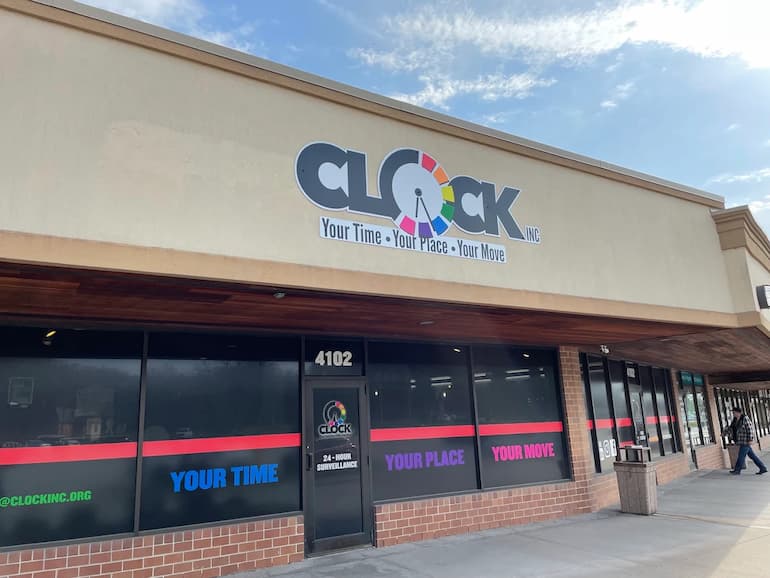
Clock Inc.’s 4,700-square-foot headquarters is at 4102 46th Ave., Rock Island, where it relocated in 2020 from its original location in downtown Rock Island just across the Centennial Bridge.
- Clock Inc. began losing revenue annually in 2023, the heart of the pro-LGBTQ+ Biden administration, gradually dropping from total funds raised of $213,296 in 2022 to 2025’s total of $191,121.
- It’s been actually losing money since 2024, when it ended the year almost $19,000 in the red on an annual budget of just over $194,000.
- Clock Inc. ended 2025 more than $17,000 in the red, even while receiving one of its highest grant award tallies ever, of at least $65,000.
- That banner year of grant funding included an award in September 2025 that was 10 times larger than the previous year from the Moline Community Foundation: a $10,000 grant award compared to just over $1,000 the year before.
- Clock Inc. was also among 53 nonprofits throughout the greater Quad Cities region that last July received three years of funding from United Way Quad Cities for an unknown share of $4.5 million.
- And while a grant award for Clock from the Quad Cities Community Foundation in January came in at $15,000 instead of the $30,000 Clock Inc. has received the last two years, Clock Inc. has also typically received two grant awards annually from the QCCF, and Round 2 hasn’t happened yet.
- Overall, for most grant rewards, it’s too early to tell if Clock Inc. has lost or gained grant funds, or why.
Explosive salary, facilities costs a factor in nonprofit’s financial struggles
Based on the nonprofit’s tax filings, which are public record, Clock’s current financial dilemma is long-simmering and related to years of disproportionate overhead costs that grew as revenue dropped.
Clock began a pattern in 2020 of increasing its overhead costs, meaning salary and facilities, at a much faster rate than its revenue increased. From 2019 to 2025 overall, Clock Inc. salaries and facilities costs grew more than eight-fold, while its revenue doubled over that six-year period.
In raw numbers, that means Clock overhead costs grew from just over $17,000 in 2019 to $171,129 in 2025, while its revenue grew from $86,875 in 2019 to $191,121 in 2025. The explosive growth in overhead costs started with facilities costs that grew seven-fold in 2020, doubled again in 2021, then grew once more by about 60 percent in 2022.
The increased costs were partly due to Clock Inc.’s current headquarters, where it moved in 2021. They were amplified by the addition of one full-time salary in 2020, and a second in 2021. COVID didn’t help – but it didn’t seem to hurt the nonprofit, either.
COVID kept Clock Inc.’s new home on 46th Avenue closed for its first year, in 2021. But Clock Inc. used the time to renovate the space with the bursting LGBTQ+ colors it’s known for. And in 2022, Clock Inc. skyrocketed to its historic high of over $213,000.
Revenue began dropping in 2023, year-end losses started in 2024
It was in 2023 that the nonprofit’s revenue began to drop, while its salary and facilities costs continued to grow. As a result, in 2024 and 2025, Clock Inc. was devoting 90 percent of its revenue to salaries and occupancy costs.
Watchdog groups recommend that salary and facilities costs together for a nonprofit consume about 35 percent of its overall revenue – or, up to 75-80 percent, if those receiving salary are deeply involved in a nonprofit’s day-to-day services and for cases like a community center.
The number of people served by the group has also not grown at nearly the same rate as Clock Inc.’s overhead costs, or even its revenue. Founder Chase Norris said in 2019, before the group moved to its new center, that Clock Inc. had served 2,600 people over 18 months – equal to about 1,733 people a year. The nonprofit says it now serves about 3,000 people annually based on undefined criteria. That’s not quite double what it was serving in 2019, when overhead costs were 10 percent what they were in 2025.

L to r: Adam Peters, Clock Inc. operations director from 2021 to 2025; Mary Francis, who started as program and innovations lead in October 2025 and has volunteered for Clock Inc. since 2019; and Chase Norris, Clock Inc. founder, executive director, and mental health counselor.
Constant fundraising, support from other groups, steady counseling revenue haven’t helped
All in all, as of 2025, Clock Inc. had received more than $984,000 in Quad Cities community support since 2019 through grants, community donations, and corporate sponsorships.
The nonprofit has also generated just over $119,000 in revenue from counseling services during that time, though it also advertises free counseling.
Since 2021, the nonprofit has held at least 258 fundraisers. In 2025, Clock Inc. averaged 1.2 fundraisers a week, and is on that same pace so far this year. The fundraisers have included trivia nights, bingo nights, telethons, birthday pleas, kayaking trips, kickball games, celebrity appeals, restaurant collaborations, art classes, merch sales, film events, and more.
Last year, the nonprofit’s famed Clockmas and Clocksgiving events – originally formed to provide a safe space for LGBTQ+ folks to have a holiday gathering – also became fundraisers, offering sponsorships. The June Pride season in particular has been an annual Clock-filled fundraising extravaganza, with a dozen or more fundraisers every year including Clock’s famed Dunk Tank filled with Quad Cities celebrities and community leaders.
Clock Inc. also added two large fundraising efforts in 2024 and 2025: the ICON variety show featuring high-profile names throughout the Quad Cities, and a “Running” fundraiser built around a local race and conducted by its former operations director, who resigned in October to run for state representative.
Just a month ago, Clock Inc. announced its annual art auction had its most successful year in the auction’s three-year history, raising $8,000. Clock Inc. also receives money from the Quad Cities’ other LGBTQ+ nonprofits and community service organizations.
The Quad Cities Pride Alliance, a nonprofit with a budget less than one-third the size of Clock Inc., has donated an unspecified amount to the group over the years, including an unspecified amount from 2026 festival proceeds, generated partly by gate fees paid by attendees.
The QCPA has also credited Clock Inc. over the years with major in-kind sponsorships of the annual Quad Cities Pride Fest, a publicity perk valued at three to four digits that QCPA has awarded Clock Inc. for holding its meetings at the Clock Inc. LGBT Community Center.
The Project of the Quad Cities has also donated to its fellow nonprofit. Neither the QCPA nor The Project responded to requests for the total dollar amount of their donations to Clock Inc. over the years.
In addition, MainStream donated two years of advertising to Clock Inc. around 2021 to 2023, valued at around $1,000 to 2,000 at the time.
Several other nonprofits much smaller than Clock Inc. have also announced since Clock’s appeal in mid-July that they, too, are donating more to Clock Inc. One Human Family QCA and MCC of the Quad Cities – both of which generate less than $100,000 annually in revenue, announced through their leader Rich Hendricks that they each donated $1,000 to Clock Inc. in July.
Specifics unavailable on Clock Inc.’s current crisis, how much needed for long-term stability
Clock Inc Program and Innovations Director Mary Francis, a volunteer with the nonprofit since 2019 before she took Clock’s leadership post in October, has not responded to requests for an interview with MainStream to help clarify the cause of Clock Inc.’s current financial crisis, its record of grant awards, its costs, the possibility of doors closing, or other factors mentioned in the current fundraising blitz.
She has, however, spoken to several other larger media, where headlines, statements and Francis’ comments refer repeatedly to grant fund reductions, increased costs and the Trump administration.
Though Francis and the articles have not mentioned any specific drop in grant funding, Francis cited to WQAD an example where Clock Inc. used to receive $20,000 and is now only receiving $500, and another citing a $20,000 grant that now provide only $5,000. MainStream could not find any record of a grant program or grant award thus far this year with those dollar levels, although sometimes grant recipients may be informed of grant awards before the general public.
In addition, no information has been provided in the articles about how and which Trump policies have affected Clock Inc, its grant sources, or its donors. Clock Inc. does not receive federal grant funding.
Clock Inc.’s founder, executive director, and only certified mental health counselor, Chase Norris, has not been quoted in any media about Clock Inc.’s financial situation. Like Francis, Norris has not responded to MainStream’s request for an interview.
He sent an email to MainStream Monday formally requesting the publication stop seeking Clock Inc.’s input to help explain Clock Inc.’s current and long-term financial crisis, or to help reconcile Francis’ comments with the nonprofit’s Form 990s and available grant award records.
Clock Inc. Board President Lexie Reiling did not return phone calls.
Francis announced through social media that the current fundraising blitz has generated enough money for Clock Inc. to “make it through August” and told WVIK Clock Inc. aims to recruit at least 1,000 donors of $5 monthly donations.
It’s unknown whether Clock Inc.’s fear of closed doors is due to any default of any kind on either a rental agreement or a mortgage for its Rock Island space.
For evictions, Illinois state law requires a process that takes an estimated 30 to 60 days and involves notice, court filings and more; no eviction filing for Clock Inc. can be found. For mortgage defaults, several steps are also required, and reaching a stage of locked doors typically takes six months or more.
Learn more about Clock Inc. here at its website, Facebook page, and Instagram account. You can also find ample coverage of Clock Inc. over the years from MainStream archives here.
(Caleb Sneeden contributed to this report)
Please read our follow-up piece this weekend about Clock Inc. finances and fundraising. Our second piece, which will take the form of analysis, includes a look at the increasing impacts of Clock Inc.’s ongoing and spreading urgent appeal for more donations; a solid plan to save Clock Inc. and end its years of crisis fundraising and financial struggle; and suggestions for adjusting the Quad Cities LGBTQ+ community’s relationship with Clock Inc. to further diversity, balance, transparency, mutual respect, equal opportunity, and greater community service.